Category Archives: localities

Gravesend Characters Past: “Governor of Coney Island”

Continuing the challenge posed by my fellow members of the Society for One-Place Studies that we blog about 52 residents of our respective places in as many weeks, I turn my attention this time to the curious stereoscopic view below. It surfaced recently, as so many fascinating treasures do, on eBay.

Wyckoff.Governor.Coney.Island.obverse

E. & H.T. Anthony & Co., stereoscopic view no. 2076, recto, “A Trip to Coney Island. / Wyckoff, Governor of Coney Island,” circa 1864-1869 [Collection of Joseph Ditta]

The image side shows a seated, portly gentleman, hands clasped across his rumpled, outdated frock coat. He wears equally unfashionable ruffles at his neck, and squints at the camera with a bemused half-smile, looking for all the world like William Claude Dukenfield, despite his flowing hair.

The reverse side of this stereoview — one in the series “A Trip to Coney Island” published by E. & H.T. Anthony & Co. circa 1864-1869 — bears the cryptic caption “Wyckoff, Governor of Coney Island.”

Most internet searches on the phrase “Governor of Coney Island” return hits for Gilbert Davis, an early owner of the Pavilion, a dancing and entertainment venue at Norton’s Point (present-day Sea Gate). Davis, who died about 1870, was a wine merchant who so relished his unofficial honorific that he marked his casks “CGI” for “Governor of Coney Island.” But Davis was an upstart newcomer to Coney Island, at least in the eyes of the Wyckoff family.
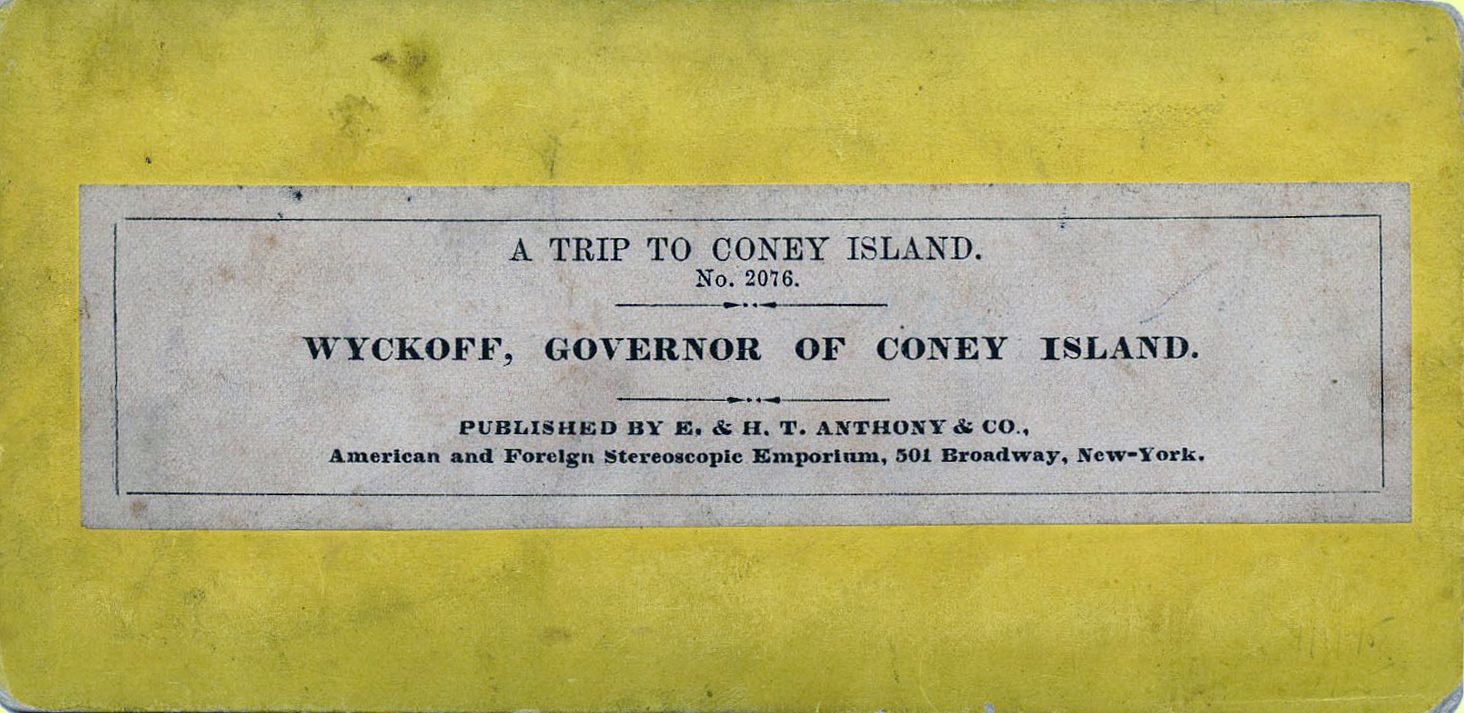
Wyckoff.Governor.Coney.Island.reverse

E. & H.T. Anthony & Co., stereoscopic view no. 2076, verso, “A Trip to Coney Island. / Wyckoff, Governor of Coney Island,” circa 1864-1869 [Collection of Joseph Ditta]

The Wyckoffs were among the first permanent European settlers of Coney Island. John Wyckoff (1787-1871), a great-great-great-grandson of Wyckoff family progenitor Pieter Claesen (died 1694), opened a seaside hotel, the eponymous Wyckoff House, in the 1840s. By the time the Anthonys issued their stereoview, Wyckoff’s son, John Jr. (1809-1873), had become proprietor.

Although the Wyckoffs are one of the best-documented families in the world, the Coney Island branch seems to have fallen through the cracks. Published information is sketchy or outright wrong. The standard genealogy of the Wyckoff family states that John Jr. died in 1868. He did not. He passed away December 8, 1873. His funeral took place three days later at the Wyckoff House, and he was buried at Holy Cross Cemetery in Flatbush. A subsequent notice in the Sag Harbor Corrector positively identifies him as the man in the stereoview:


Copyright © 2015 by Joseph Ditta (webmaster@gravesendgazette.com)

Leave a comment

Filed under Coney Island, families, Gravesend characters, John Wyckoff, localities, Wyckoff family

Gravesend Characters Past: The White Rats Picnic of 1910

Ulmer.Park.White.Rats.1910.08.04.band.watermarked

“Band at White Rats outing Ulmer Park Aug 4th 1910.” Photography by Jack Rossley published in the New York Clipper on Saturday 20 August 1910 with the caption “The White Rats Band.” [Collection of Joseph Ditta]

Is it finally spring? The calendar says so, but these fluctuating temperatures have yet to break free of winter. We’re all ready for outdoor activities sans umbrellas and boots. Continuing the challenge posed by my fellow members of the Society for One-Place Studies that we blog about 52 residents of our respective places in as many weeks, my thoughts turn this time to long-gone Ulmer Park, at the foot of 25th Avenue on Gravesend Bay, the setting for countless warm-weather excursions, such as the picnic-cum-baseball game thrown by the White Rats in 1910. The White Rats was a short-lived labor union of male vaudeville performers founded by the monologist George Fuller Golden (who penned a 1909 history of the organization, My Lady Vaudeville and Her White Rats). Although the Manhattan-based White Rats were not technically residents of Gravesend, and thus outside my loose definition of “Gravesend characters,” they did visit for a day, and left this record of how they spent their time:

New York Clipper, Saturday 13 August 1910 (p. 649, col. 5).

THE WHITE RATS OUTING.

The annual Summer affair of the White Rats was held at Ulmer Park, Brooklyn, N.Y., Thursday, Aug. 4, and proved to be a big success, despite the threatening weather early in the day. The White Rats Band led the procession, down Broadway to the Thirty-third Street station, where the members and their families took the car for Brooklyn. Mayor Harry Thomson headed the parade. As the train passed Greenwood Cemetery, the band struck up “Has Anybody Here Seen Kelly?”

1907 overview of William Texter's Ulmer Park. [Collection of Joseph Ditta]

A 1907 overview of William Texter’s Ulmer Park at the foot of 25th Avenue, Gravesend Beach, Brooklyn. [Collection of Joseph Ditta]

At the athletic grounds refreshments were served and two nines from the Rats played an exciting ball game, with the score 11 to 10 at the finish. The Freeport, L.I., Rats arrived in seven automobiles. They brought their baseball suits, and quickly challenged the New Yorkers for a contest on the diamond. The teams [lined?] up as follows:

Freeports: Cartwell[?], Morton [Sam Morton, Director], Smith, Pettet, Bailey, Austin, Castenbeer[?], Middleton and Kelm. New Yorks: McCree [Junie McCree, Vice-President], Platti[?], Felix [Geo. Felix, Director], Jerome, Klein, Barnes, Lorella [Colie Lorella, Trustee], Brockman and Jenkins. Umpires: Potts and Dody.

After a series of strike-outs, knock-outs and other laughable incidents, interrupted occasionally by some real ball playing, the score stood 9 to 1 in favor of the Out-of-Towners. Several photos were taken by Jack Rossley, who has favored THE CLIPPER with copies of them, which will appear in our next issue.

[Two of Rossley’s photos, the originals of which were found tucked inside a copy of Golden’s My Lady Vaudeville, are reproduced here. They were published in the New York Clipper on Saturday 20 August 1910, p. 671, col. 3.]

Ulmer.Park.White.Rats.1910.08.04.baseball.watermarked

“White Rats Outing Aug. 4 / 10 Ulmer Park B’klyn NY.” Photograph by Jack Rossley published in the New York Clipper on Saturday 20 August 1910 with the caption “The White Rats Ball Team and the Rooters.” [Collection of Joseph Ditta]

Mike Conkley[?] was a successful coach. Among the rooters were Major Doyle [Major James D. Doyle, Director], Joe Phillips, “Pop” Donegan, John World, Tom Lewis, who had got his second wind after playing in the first game; Harry Thomson, Harry Mountford [Secretary to Board of Directors], Tim Cronin [Director], Mattie Keene, Fred Buskirk, Frank Evans, Billy Hart, Mlle. Marie, Andy McLeod, Kelly and Ashby, and M. Keeler. The ladies enjoyed the fun immensely, and the band made a big hit. After supper the Freeporters automobiled homeward, and the Manhattanites trained it to Thirty-fourth Street, and from there paraded with the band to the clubrooms.


Copyright © 2015 by Joseph Ditta (webmaster@gravesendgazette.com)

Leave a comment

Filed under Gravesend characters, Ulmer Park

Gravesend Characters Past: The Dog Who Would Not Be Saved

Continuing the challenge posed by my fellow members of the Society for One-Place Studies that we blog about 52 residents of our respective places in as many weeks, I turn my attention this time to a troublesome four-legged Gravesender. As the Brooklyn Eagle reported on Monday 9 February 1948:

Cold Dog on Ice Floe Is Hot Potato For C.G., P.D., F.D., A.S.P.C.A.

An ungrateful stray pup grudgingly accepted the hospitality of the A.S.P.C.A. shelter at 233 Butler St. today while the Police and Fire Departments, United States Coast Guard and the A.S.P.C.A. hoped the mutt would never venture onto an ice floe again.

The mongrel, mostly white Spitz, was discovered yesterday sitting forlornly on a six-foot cake of ice in Gravesend Bay, off Bay 35th St. The floe was about 200 feet from shore and 100 feet from the end of a pier. The dog’s plight was noticed by householders who had gathered to get kerosene from the Bay Fuel Oil Co. terminal.

Police Sgt. George Huson of the Bath Beach station, on fuel detail at the terminal, attempted to lure the stray dog to shore by waving some dog food. The pup was not interested. Then August Rizler, 30, of 535 Park Ave., a driver for the A.S.P.C.A., arrived with a rescue truck.

Rizler crawled out on the ice, using several sheets of corrugated sheet steel and three ladders placed end-to-end to get near his quarry. He tossed food to the dog and attempted to drop a net over his head. The dog grabbed the food but backed away and Rizler fell into the water. He got back to the shore, made another attempt and fell in the water again. He got back to shore the second time.

Gravesend.Bay.ice.dog.MINE.obverse

ACME TELEPHOTO of the rescue of the ungrateful pooch from icy Gravesend Bay. Note the arrow pointing to the dog. For orientation, the apartment building at far right is the Lena Arms, at 2315 Cropsey Avenue, corner of Bay 34th Street. [Collection of Joseph Ditta]

Police Launch No. 1 from 39th St., chugged into view off the pier with Sgt. Fred Mohrmann in command. Because of the closely packed ice the launch could not get near the dog.

So Hook and Ladder Company 149 pulled up to the pier and dropped its 85-foot extension ladder. Fireman John Carian climbed to the tip with a 50-foot rope, which proved too short. Then the Coast Guard–skilled in sea-rescues–confidently reached the scene in a cutter, but shallow water kept the 64-foot boat away from the pooch.

Finally, six hours and 15 minutes after rescue attempts had been started, three civilians in a 12-foot sailboat propelled by poles, rescued the dog. They were Fred Landa, 27, of 8871 18th Ave. and Jack West, 38, of 2055 85th St., who operate a flying school near the scene, and Nathan Levy, 32, a pilot.

While Landa and West poled, Levy draped himself over the bow and kicked ice cakes out of the way with his feet. Nearing the dog Landa jumped out and began playing tag with it. As Landa jumped from one cake the dog jumped to another. Finally, he enticed the pooch with some food–after it tried to bite him–and he got into the boat with the dog. Meanwhile, West fell in the water. He, too, climbed back into the boat, which was then pulled to shore with a pier line.


Copyright © 2015 by Joseph Ditta (webmaster@gravesendgazette.com)

Leave a comment

Filed under Gravesend Bay, Gravesend characters

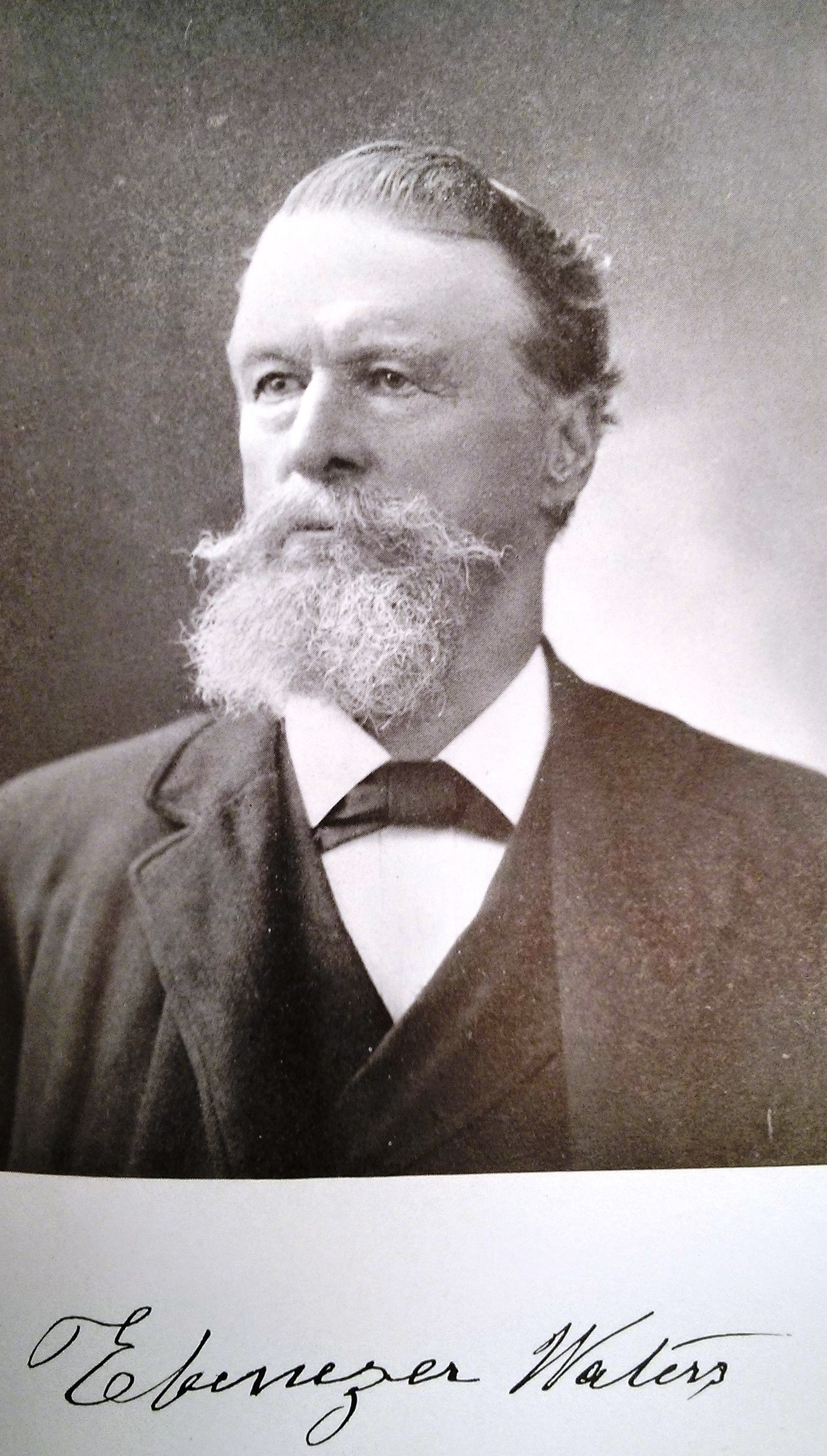
Gravesend Characters Past: Ebenezer Waters, D.V.S. (1834-1908)

Continuing the challenge posed by my fellow members of the Society for One-Place Studies that we blog about 52 residents of our respective places in as many weeks, here is a profile of Gravesend veterinarian Ebenezer Waters transcribed from Peter Ross, A History of Long Island From its Earliest Settlement to the Present Time, vol. 3 (New York: Lewis Publishing Company, 1902), 324-325:

image

Ebenezer Waters (1834-1908)

Ebenezer Waters is a veteran veterinarian of Brooklyn and is one of the native residents of Long Island, his birth having occurred in Gravesend, Kings county, on the 2d of September, 1834. His parents were Dr. Robert and Doellinor (Lancaster) Waters, natives of London, England. The father, who was a veterinary surgeon of his native country, came to America in 1828, located at Flatlands, where he remained for two years. In 1830 he removed to Gravesend and twenty years later to New Utrecht, where he died in 1862, at the age of fifty-six years. His widow died in 1891, at the age of eighty-four years, and her mother was ninety-eight years and eleven months old at the time of her demise. In their family were nine children.

The father owned a farm of sixty acres, on what is known as Dyker Heights, and there his sons as young men were employed, but the Doctor’s time was chiefly given to assisting his father in the practice of veterinary surgery. He became his successor in business and for some time was the only veterinarian between Fort Hamilton and Jamaica. In 1871 he purchased a stable at No. 113 Ashland Place, where he has since conducted his veterinary hospital.

In 1855 Dr. Waters was united in marriage to Miss Gertrude Van Pelt of New Utrecht. By this union there were two children, who died in infancy, and the mother died in 1861. In 1864 the Doctor wedded Miss Jane Maria Van Sicklin [sic], of Coney Island, who died in 1869. They had three children, the two eldest being twins, one of whom died at the age of eight and the other at fourteen months. The surviving child is Roberta L. The Doctor was married a third time, in 1871, when Miss Mary Elizabeth Bennett, of New Utrecht, became his wife. She was a descendant of an old Long Island family, and died in September, 1896. The Doctor holds membership relations with Fortitude Lodge No. 19, F. & A. M. [Free & Accepted Masons]; Nassau Chapter, No. 109, R. A. M. [Royal Arch Masons]; and Clinton Commandery, No. 14, K. T. [Knights Templar]. He was formerly a member of the Prospect Driving Club and the Atlantic Yacht Club. In politics he has always been a stanch [sic] supporter of Democracy.


Copyright © 2015 by Joseph Ditta (webmaster@gravesendgazette.com)

Leave a comment

Filed under Bennett family, Dyker Heights, Ebenezer Waters, Van Pelt family, Van Sicklen family

Thanksgiving Basket for Old Saar

“On the way to the Cedars at Sheepshead Bay, N.Y.” Card postmarked Brooklyn, November 12, 1909. (Collection of Joseph Ditta)

During the early years of the 20th century, the poet-historian Gertrude Ryder Bennett (1901-1982), who lived her entire life in the landmarked Wyckoff-Bennett Homestead (built around 1766, it stands proudly at 1669 East 22nd Street), went with her parents one Thanksgiving to deliver a charitable wagon-load of food and winter supplies to “Old Saar,” a woman thought to be a surviving Canarsie Indian. Old Saar was supposedly over 100 years old and lived in a dirt-floored shack in the section of Gravesend Neck called “Hog Point Cedars,” or sometimes just “the Cedars,” located in the marshy reaches east of Sheepshead Bay near Plumb Beach/Gerritsen Beach. Here is Gertrude’s poignant remembrance of that long-ago day. (FYI: “the cove” = Sheepshead Bay.)

Thanksgiving Basket

My parents took me with them when they drove

To Hog Point Cedars. Long ago that name

Sank to oblivion. Beside the cove

Our Blackie jogged. We knocked and Old Saar came

To ask us in her weather-beaten shack,

Her long, white hair in braids, her placid face

Like my dried apple doll. Her eyes were black

And keen. One single window pane. The place

Had only earth for floor. Her feet were bare

Although, across the dunes, the wind blew cold.

I had been told she always had lived there,

That no one knew her age, she was so old.

She wore a wrapper, with a brilliant stripe,

Of summer weight, and smoked a corn-cob pipe.

—————–

She spoke to me through wrinkled lips. Her hand

Caressed my hair. My parents brought the food

Out of the carriage and I watched her stand

Bright eyed. “My son’s out back. He’s choppin’ wood,”

She said, “and he’ll be eighty come next year.

He’s just been clammin’.” Then she proudly chose

The best to share with us while I could hear

Ax upon driftwood. When the inlet froze,

They would have staple food that bleak November.

“Canarsie Indians,” folk said. They were

The last. Though long ago, I still remember

A certain air of mystery in her,

Her walk, slow but erect, kindness to me,

And childish wonder at her dignity.

[From the chapter “Basket for Old Saar” in Turning Back the Clock in Gravesend: Background of the Wyckoff-Bennett Homestead (Francestown, N.H.: Marshall Jones Company, 1982), 25-26.]

Another section of town, on the shore of Gravesend Bay, was also called “The Cedars.” This illustration appeared in F.A. Busing’s Brooklyn Landmarks Calendar for 1902. (Collection of Joseph Ditta)


Copyright © 2011 by Joseph Ditta (webmaster@gravesendgazette.com)

8 Comments

Filed under holidays, Sheepshead Bay