Maurice Sendak, Gravesend’s Own

The recent death of iconic children’s book author and illustrator Maurice Sendak (10 June 1928 – 8 May 2012), perhaps best known for his 1963 Where the Wild Things Are, reminded us that he was a native Brooklynite. Folks recalled that their parents attended the same schools Sendak did. Michael C. Marmer went one step better and produced a block print by Sendak that accompanied an essay his mother, Ruth (Luberoff) Marmer, composed for a Lafayette High School publication around 1947. The Bensonhurst Bean: Bensonhurst’s Premier News Blog speculated that the image — of a seated, emotionally drained man holding a hand to his forehead and in his lap a crumpled newspaper with the headline “WAR ENDS” — might possibly have been Sendak’s earliest published work. (Be sure to read Marmer’s touching story detailing his search for a copy of his mother’s essay.)

But Sendak illustrated another school publication at least four years before the one for Lafayette: his work appeared on the cover of the June 1943 Boody Beacon, the yearbook of David A. Boody Junior High School at 228 Avenue S in Gravesend. Where the Lafayette illustration depicts a man worn down by war, the Boody image shows a younger, confident figure progressing from farmer to riveter to soldier.

Cover of the Boody Beacon, June 1943, signed at lower right: “Maurice Sendak 9B1.”

Sendak graduated from Boody in class 9B1. His photo is on page 28 of the Beacon, where he stands in the third row from the top, second from left.

Detail of page 28 of the Boody Beacon, June 1943, showing Maurice Sendak, third row from top, second from left.

Incidentally, for those who insist on claiming Maurice Sendak as a son of Bensonhurst, we present the following page from the 1940 U.S. federal census, which shows the Sendak family (on lines 20 through 24) — parents Philip and Sadie with their children Nettie, Jack, and eleven-year-old “Morris” — living at 1717 West 6th Street, between Quentin Road and Kings Highway. That’s right smack in the middle of Gravesend.

1940 U.S. census showing “Morris” Sendak (line 24) living at 1717 West 6th Street, Gravesend, Brooklyn, New York.

(The prior federal census, 1930, shows the Sendaks at 408 Montauk Avenue in East New York. That’s  definitely not Bensonhurst!)

By April 26, 1942, when Sendak’s father, Philip, filled out his World War II draft registration card, the family had moved to 1518 West 4th Street, between Avenues O and P, still within walking distance of Boody.
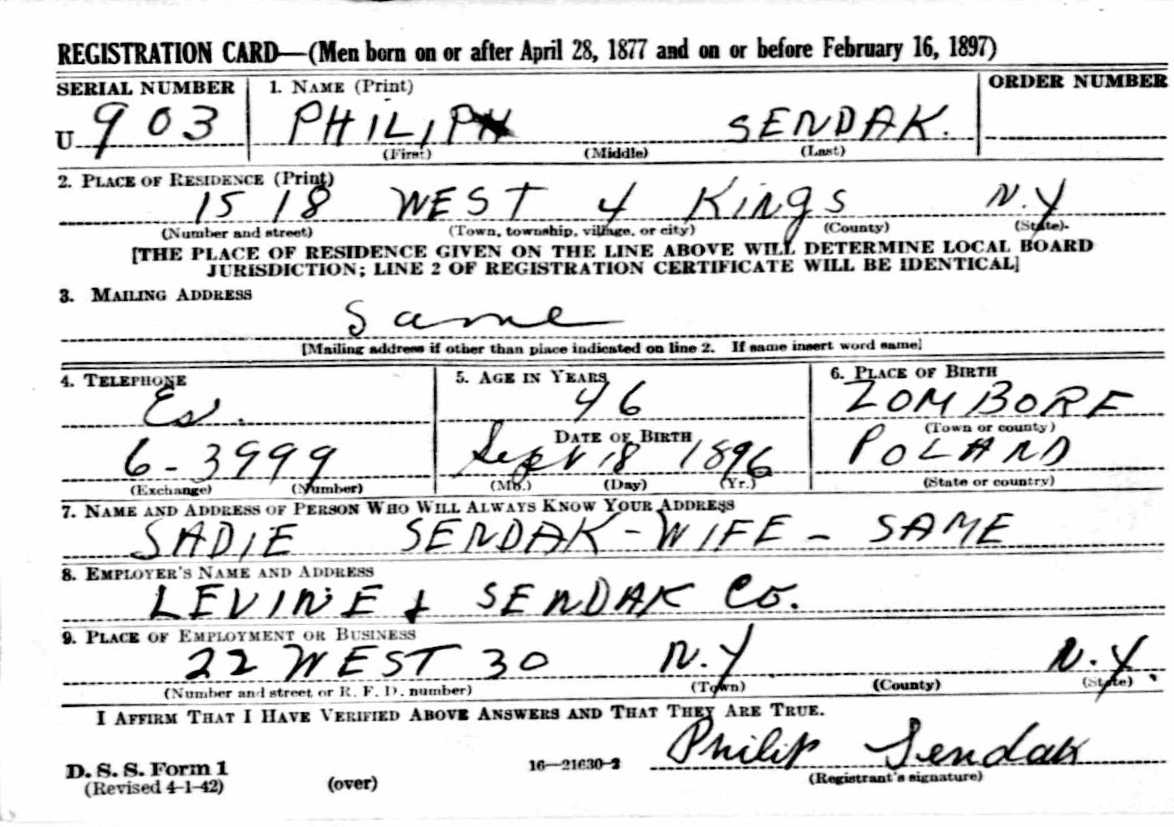
World War II draft registration for Philip Sendak, father of Maurice.


Copyright © 2012 by Joseph Ditta (webmaster@gravesendgazette.com)

2 Comments

Filed under David A. Boody Junior High School, Lafayette High School, Maurice Sendak, schools

Christmas Dream

This card — which I am taking the liberty of appropriating to send you with my best wishes — was painted for Christmas, 1893, by the artist Charles William Bauhan (ca. 1861-1938), who was living then in Gravesend, hence the compound of “Gravesend” and “Dream” along the left side of the card: “GRAVESENDream of ’93.” The vignettes include a smaller version of his watercolor of Homer Wiltse tending his garden (upper left; the original is reproduced on the title page of Then & Now: Gravesend, Brooklyn); a side view of the Lady Moody House with the Reformed Dutch Church beyond (to the right of the woman leaning out of the window, who was probably his wife, Agda, also an artist); a view of the Wiltse House at 15-17 Gravesend Neck Road (below the previous image); and a view looking east on Neck Road to the Gravesend Town Hall (lower right). The toddler playing on the steps just above the ’93 (who is also depicted as an infant in his cradle between the words “Merry” and “Christmas”) was probably the artist’s son, the noted Princeton architect Rolf W. Bauhan (1892-1966).

Charles W. Bauhan, painted Christmas card, 1893. (Collection of Joseph Ditta)


Copyright © 2011 by Joseph Ditta (webmaster@gravesendgazette.com)

Leave a comment

Filed under Charles William Bauhan, Gravesend artists, holidays

Thanksgiving Basket for Old Saar

“On the way to the Cedars at Sheepshead Bay, N.Y.” Card postmarked Brooklyn, November 12, 1909. (Collection of Joseph Ditta)

During the early years of the 20th century, the poet-historian Gertrude Ryder Bennett (1901-1982), who lived her entire life in the landmarked Wyckoff-Bennett Homestead (built around 1766, it stands proudly at 1669 East 22nd Street), went with her parents one Thanksgiving to deliver a charitable wagon-load of food and winter supplies to “Old Saar,” a woman thought to be a surviving Canarsie Indian. Old Saar was supposedly over 100 years old and lived in a dirt-floored shack in the section of Gravesend Neck called “Hog Point Cedars,” or sometimes just “the Cedars,” located in the marshy reaches east of Sheepshead Bay near Plumb Beach/Gerritsen Beach. Here is Gertrude’s poignant remembrance of that long-ago day. (FYI: “the cove” = Sheepshead Bay.)

Thanksgiving Basket

My parents took me with them when they drove

To Hog Point Cedars. Long ago that name

Sank to oblivion. Beside the cove

Our Blackie jogged. We knocked and Old Saar came

To ask us in her weather-beaten shack,

Her long, white hair in braids, her placid face

Like my dried apple doll. Her eyes were black

And keen. One single window pane. The place

Had only earth for floor. Her feet were bare

Although, across the dunes, the wind blew cold.

I had been told she always had lived there,

That no one knew her age, she was so old.

She wore a wrapper, with a brilliant stripe,

Of summer weight, and smoked a corn-cob pipe.

—————–

She spoke to me through wrinkled lips. Her hand

Caressed my hair. My parents brought the food

Out of the carriage and I watched her stand

Bright eyed. “My son’s out back. He’s choppin’ wood,”

She said, “and he’ll be eighty come next year.

He’s just been clammin’.” Then she proudly chose

The best to share with us while I could hear

Ax upon driftwood. When the inlet froze,

They would have staple food that bleak November.

“Canarsie Indians,” folk said. They were

The last. Though long ago, I still remember

A certain air of mystery in her,

Her walk, slow but erect, kindness to me,

And childish wonder at her dignity.

[From the chapter “Basket for Old Saar” in Turning Back the Clock in Gravesend: Background of the Wyckoff-Bennett Homestead (Francestown, N.H.: Marshall Jones Company, 1982), 25-26.]

Another section of town, on the shore of Gravesend Bay, was also called “The Cedars.” This illustration appeared in F.A. Busing’s Brooklyn Landmarks Calendar for 1902. (Collection of Joseph Ditta)


Copyright © 2011 by Joseph Ditta (webmaster@gravesendgazette.com)

8 Comments

Filed under holidays, Sheepshead Bay

A soggy day in Gravesend town

P.L. Sperr, “Street Crossing Avenue Y at E. 11 St. Sheepshead Bay, Brooklyn, after Sunday Downpour.” (Collection of Joseph Ditta)

No, these Sheepshead Bay ladies aren’t cooling their heels in the surf. They are wading across the flooded intersection of Avenue Y and East 11th Street after a violent thunderstorm soaked the region on Sunday, July 9, 1933. The view is looking northwest (the frame house behind the tree is 2472 East 11th Street), with the ladies standing in the middle of Avenue Y, just two blocks west from where Squan Creek, a wiggly tributary of Coney Island Creek, once flowed freely through the grass. The early years of the twentieth century brought such drastic development to marshy southern Brooklyn that its newly asphalt-covered landscape could not cope with such sudden downpours. Let’s hope that in the 78 years since this photo was taken the sewers in our low-lying neighborhoods will be better equipped to drain off the rains of Hurricane Irene come Sunday.


Copyright © 2011 by Joseph Ditta (webmaster@gravesendgazette.com)

1 Comment

Filed under Sheepshead Bay, weather

Letter from Gravesend, 1855

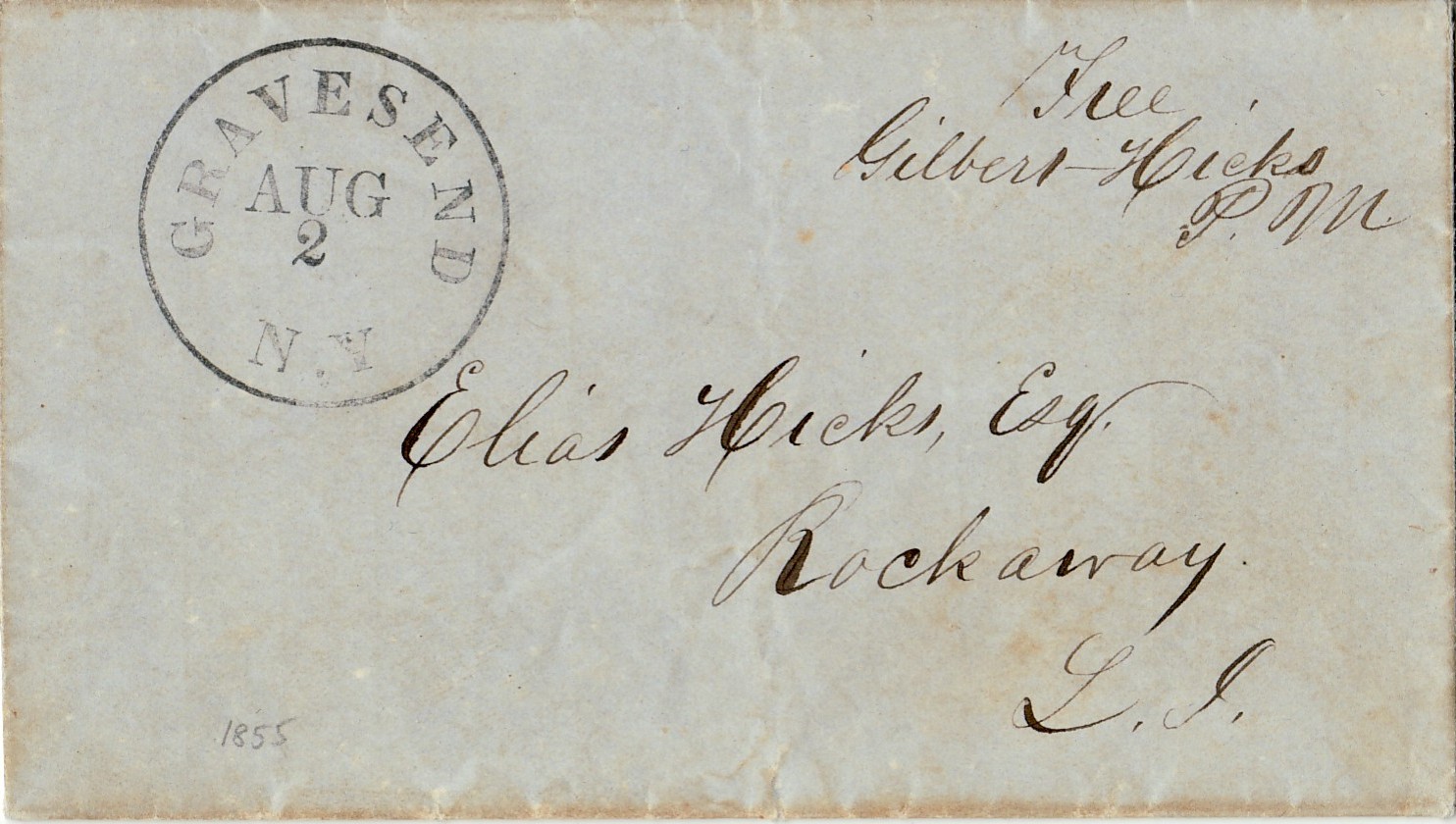
Before 1843 letters destined for Gravesend, which had no post office, went instead to Flatbush, where any passing resident could collect his mail and any for his neighbors to deliver at leisure. Shopkeeper Martin Schoonmaker became the town’s first postmaster that year, and he served until 12 July 1854, when he was succeeded by 22-year-old fisherman Gilbert Hicks. Hicks, a son of Thomas and Cornelia (Van Sicklen) Hicks, was born at Norton’s Point (now Sea Gate), Coney Island, on 6 March 1832, but by the time of his appointment as postmaster, he was living with his family in the house now known as 27 Gravesend Neck Road–commonly called “Lady Moody’s House”–which his mother’s Van Sicklen ancestors had owned for generations. Eventually he moved to Flatbush, where he died in 1903.

In the letter below, dated 1 August 1855 and postmarked the following day, he wrote to his uncle Elias, who lived in Rockaway, then a part of the town of Hempstead, which belonged to Queens County until 1898. Note the use of his franking privilege as postmaster to send the letter free of charge.

Letter from Gilbert Hicks to Elias Hicks, postmarked Gravesend, 2 August 1855 (Collection of Joseph Ditta)

“Dr. Baisley” is probably Robert B. Baisley, a Rockaway physician born around 1819; he does not appear to have been appointed to the position discussed. And the “melancholy accident at Coney Island” refers to the drowning deaths of the Rev. John H. Elliot of Williamsburg(h) and his daughter, who were dragged down by the undertow while bathing near the Oceanic House on 25 July.

Gravesend Aug 1st 1855

Dear Uncle Elias

Mr. Samuel Hubbard of this village, who is one of the Superintendents of the Poor of Kings County wishes me to write to you for some information, which he thinks you can give him. He says that the new Lunatic Asylum at Flatbush is completed, and that at the next meeting of the Board of Superintendents they will most likely appoint a physician to take charge of it. There are several applicants for the appointment, and among them a Doctor Baisley of Rockaway. The Superintendents desire to appoint a capable and worthy physician: one well qualified to discharge the duties which would necessarily devolve upon him in the Institution.

Mr. Hubbard thinks it very probable that you are acquainted with Dr Baisley, and can furnish him with some information respecting him. Mr H. would be greatly obliged to you if you would write immediately (or as soon as you can possibly) and give him your opinion of Dr Baisley, and also state whether you think he would be a proper person for so responsible an appointment. It is worth a thousand dollars a year. Direct the letter to Mr Hubbard who will consider it strictly confidential.

We are all as well as usual. Fish are unusually scarce just now but bring a good price. Mother went to Aunt Fanny’s week before last. She found all the folks there well.

I supposed you have read the newspaper accounts of the melancholy accident at Coney Island. I am unable to add anything to those accounts. Had the proprietors of the bathing houses furnished their establishment[s] with boats, ropes &c as they should have done no lives would have been lost. Now, after the accident has occurred, they have got them. There are very few boarders at the boarding houses on the Island this season, and since the accident on the shore the bathing house has been but poorly patronised. People are afraid to venture into the water.

The farmers, here, are carrying their potaters to market as fast as they can get them out of the ground. They are worth from 4/6 to 5/6 per bushel. The wet weather if it continue[s] much longer, it is feared will set them rotting.

Uncle Elias we would be very happy to have you make us a visit. It is quite a long while since you were here last. If I can spare the time, I will try to make you a short visit next Fall. I would like dearly to visit Far Rockaway.

I have not received a letter from Uncle Isaac in a long while but I occasionally receive papers.

Give my best wishes to Uncle William, and to Potter.

Respectfully yours,

Gilbert Hicks


Copyright © 2011 by Joseph Ditta (webmaster@gravesendgazette.com)
2 Comments

Filed under Coney Island, families, Hicks family, postal history, Van Sicklen family