Gravesend Characters Past: Thomas Ferguson (1845-1903)

Continuing the challenge posed by my fellow members of the Society for One-Place Studies that we blog about 52 residents of our respective places in as many weeks, here is a profile of Thomas Ferguson, transcribed from Peter Ross and William S. Pelletreau, A History of Long Island From its Earliest Settlement to the Present Time (New York and Chicago: Lewis Publishing Company, 1905), vol. 3, pp. 136-7:

Thomas Ferguson (1845-1903)

Thomas Ferguson (1845-1903)

Thomas Ferguson, deceased, for many years a foremost citizen of Brooklyn, known for his success in commercial affairs and for his intelligent enterprise in promoting community interests, as well as for his lovable personal traits of character, was of Scotch ancestry and birth, coming from the same sturdy stock which contributed so largely to the settlement of New York and the contiguous region, and which bore so useful a part in the founding of religious and educational institutions in the new world.

He was born in Scotland in June, 1845. He acquired a broad and liberal education, being predisposed to a ministerial life, a calling from which he turned aside on account of threatened ill health which promised to impair his usefulness as a clergyman. But the moral qualities which had impelled him to look to the ministry were deeply planted and governed his conduct throughout his entire life, and were the inspiration which lay at the bottom of his every act, whether in business or social life.

In 1866, having reached the years of manhood, Mr. Ferguson came to Brooklyn, New York, and became associated in business with his uncle, John F. Phillips, who was extensively engaged in the whiting business in Brooklyn. The firm conducted business with marked success, and was known to the mercantile world as the largest importers of whiting in the country.

During these years, Mr. Ferguson was also busied with important enterprises which were at once profitable to himself and of marked advantage to the community. With characteristic foresight and excellent business judgment, he made early and large investments in Gravesend real estate, and for some years prior to his death he was known as one of the most extensive individual property holders in that beautiful suburb. He was for many years a commissioner of common lands of Coney Island. He was a leader in a few of the most prominent clubs–the Amaranth Club, of which he was president for two years; the Montauk Club, and the Union League Club. His connection with these was, however, only in lines of usefulness; for, while a man of excellent social traits, his great delight was in his home and family.

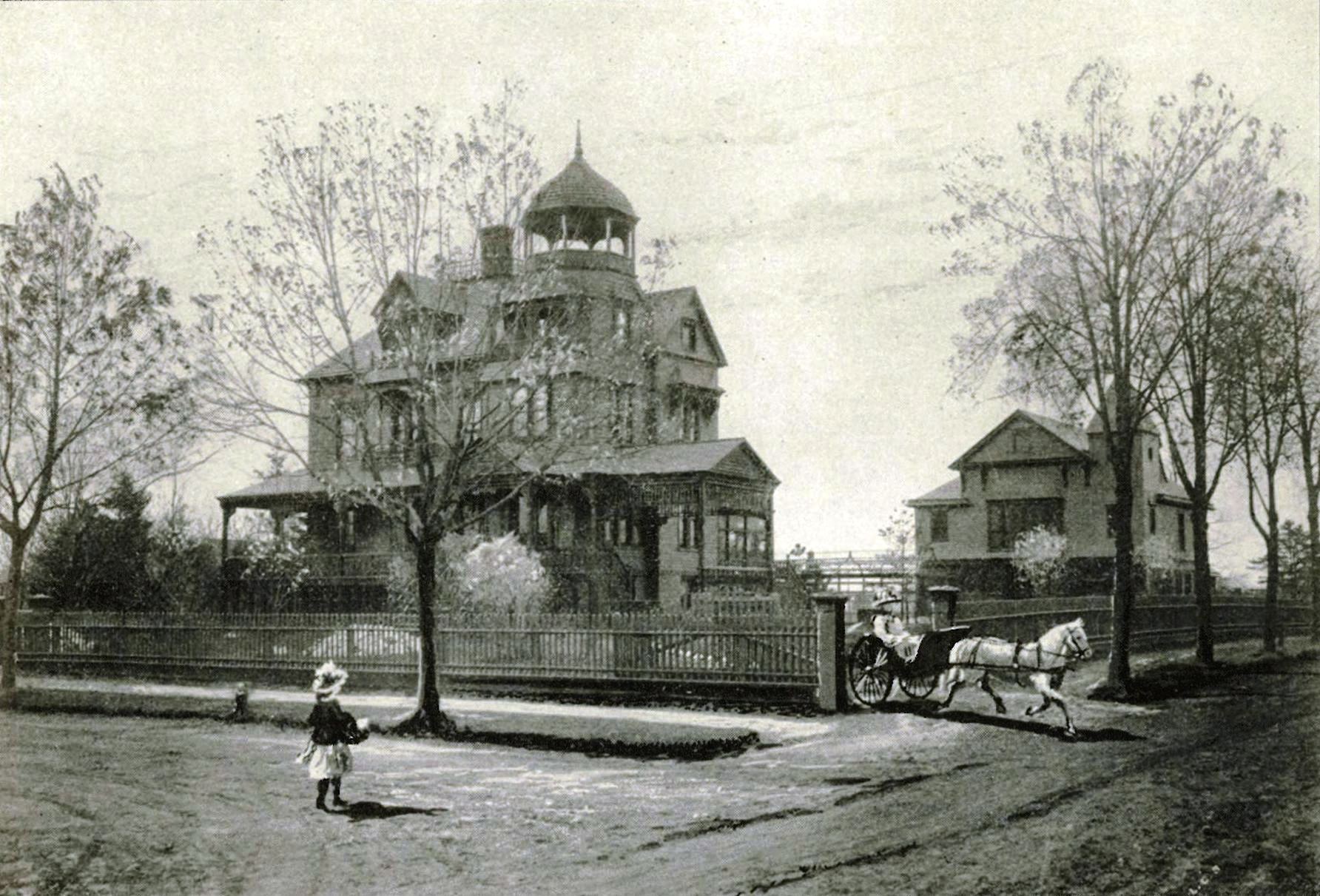
Mr. Ferguson was married in 1879 to Miss Lizzie C. Gibson, of Philadelphia, Pennsylvania. She was a well educated lady, of cultured tastes, and in hearty accord with her husband in all his concerns, aiding him with her counsel in his many liberal benefactions to charitable institutions and to individuals, and presiding over his home with charming grace. The family residence on Ocean Parkway, one of the most beautiful in all that region, was ever open to their many friends, to whom they dispersed a generous hospitality.

Ferguson.Thomas.residence.scan.2012.cropped

Thomas Ferguson residence as depicted in Jere. Johnson Jr., Building a Nation and Where to Build Ideal American Homes (1891). The Ferguson house stood at 1375 Ocean Parkway near the northeast corner of Avenue N.

This beautiful association was closed by the death of Mr. Ferguson on January 23, 1903. He had not yet completed his fifty-eighth year, and the end came when he was in the fulness of his mental powers, when his usefulness appeared to be of increasing worth to his fellows, and when all happiness and comfort was in his home. The sad event awakened sincere sorrow throughout the community, a sorrow which found expression among all classes. The character of Mr. Ferguson was feelingly depicted by his pastor, who referred to him as a man of sterling worth, physically strong, mentally alert, and morally sound, a sincere Christian gentleman. Those who had been associated with him in business affairs spoke in terms of unstinted praise of his strict integrity, fine sense of honor, and charitableness of disposition in all his relations, whether in business or in social life. He was a man broadly generous in all cases which appealed to him as deserving, but so modest in the bestowment of his beneficences that his good works went unknown except as they were heralded by the recipients of his bounty. And so he left to her who survived him, and to the friends at her side, the fragrance of a memory without blemish, the recollections of a beautiful life.

Copyright © 2015 by Joseph Ditta (webmaster@gravesendgazette.com)

Leave a comment

Filed under Ferguson family, Gravesend characters, Ocean Parkway, Thomas Ferguson

Gravesend Characters Past: John L. Voorhies (1832-1898)

Continuing the challenge posed by my fellow members of the Society for One-Place Studies that we blog about 52 residents of our respective places in as many weeks, here is a profile of John L. Voorhies from The Eagle and Brooklyn: The Record of the Progress of the Brooklyn Daily Eagle Issued in Commemoration of its Semi-Centennial and Occupancy of its New Building; Together With the History of the City of Brooklyn From its Settlement to the Present Time, edited by Henry W. B. Howard (Brooklyn, N.Y.: The Brooklyn Daily Eagle, 1893), vol. 2, 1141:

John L. Voorhies (1832-1898)

John L. Voorhies (1832-1898)

For fifteen years JOHN L. VOORHIES has been town clerk of Gravesend, and for seven years he has filled the responsible post of commissioner of investment. He was born at Gravesend, on January 21, 1832. At the little red schoolhouse on Gravesend Neck road he received such instruction as was generally imparted in those days, and early in his teens engaged in the pursuit of farming. In 1877 he was elected town clerk; he ran as an independent candidate, but received the votes of both Democrats and Republicans. The term of office was then only one year, and he was re-elected each succeeding year, until 1880, when the term was increased to three years. In January, 1885, he was appointed to serve an unexpired term of two years as commissioner of investments for the monies derived from the sales of common lands at Gravesend. Upon the expiration of the term mentioned, the supervisors appointed Mr. Voorhies to the position of town treasurer and town clerk, the term expiring on June 19, 1893. he is a staunch Democrat, and serves his party well by serving the community well, but does not affiliate with any political organization.

Invitation to the tenth wedding anniversary celebration of John L. and Frances E. (Hicks) Voorhies, 22 November 1887. Frances was the second Mrs. Voorhies; the first -- Ellen Ann (Johnson) Voorhies -- died in 1875. [Collection of Joseph Ditta]

Invitation to the tenth wedding anniversary celebration of John L. and Frances E. (Hicks) Voorhies, 22 November 1887. Frances was the second Mrs. Voorhies; the first — Ellen Ann (Johnson) Voorhies — died in 1875. [Collection of Joseph Ditta]


Copyright © 2015 by Joseph Ditta (webmaster@gravesendgazette.com)

2 Comments

Filed under Gravesend characters, Hicks family, John L. Voorhies, Voorhies family

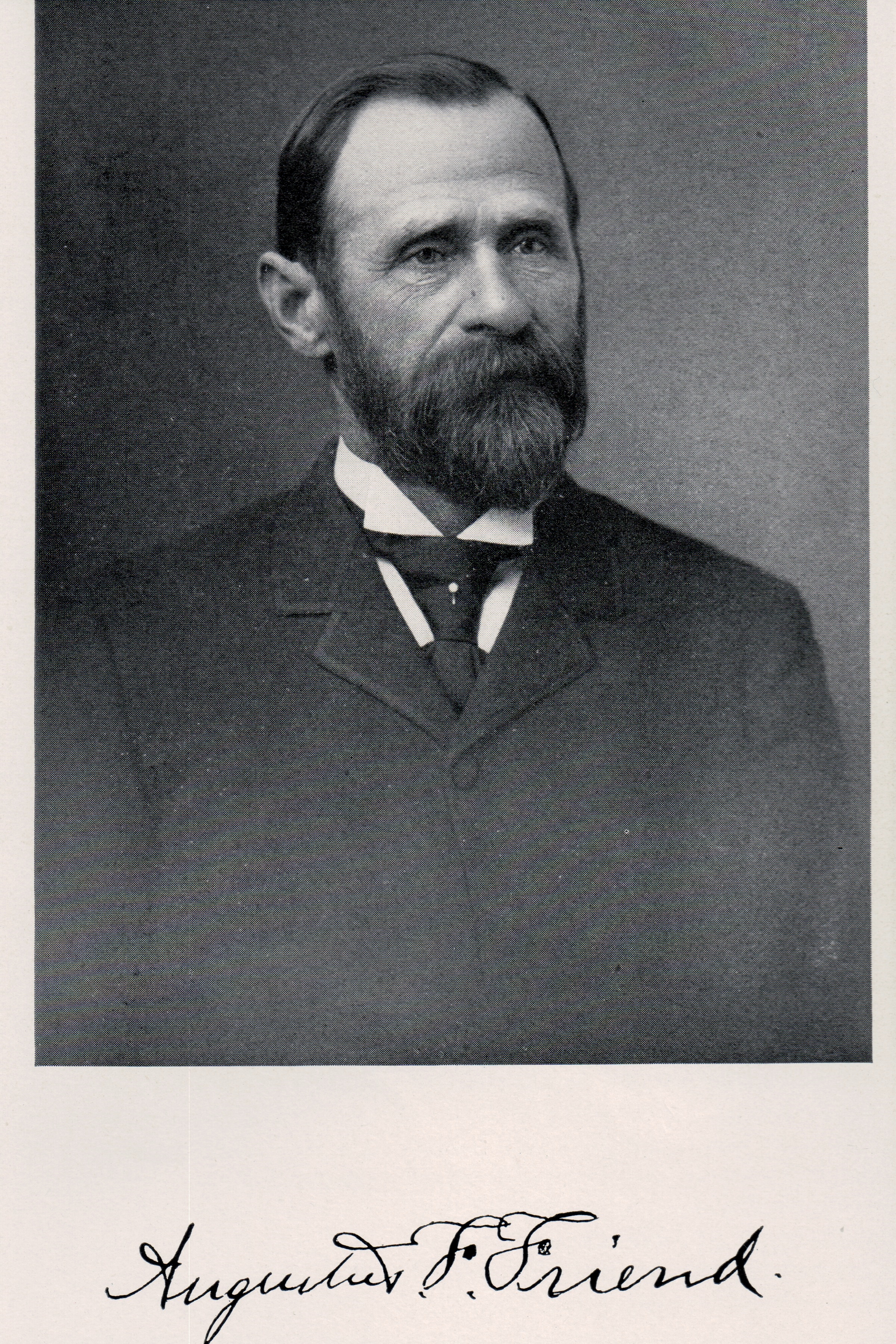
Gravesend Characters Past: Augustus F. Friend (1840-1933)

Continuing the challenge posed by my fellow members of the Society for One-Place Studies that we blog about 52 residents of our respective places in as many weeks, here is a profile of Augustus F. Friend, Gravesend blacksmith, from Peter Ross, LL. D., A History of Long Island From its Earliest Settlement to the Present Time, vol. 2 (New York: Lewis Publishing Company, 1902), 386-387:

Augustus F. Friend (1840-1933)

Augustus F. Friend (1840-1933)

In the subject of this review we find a worthy representative of the industrial interests of Gravesend and one of its popular business men. He was born at New Utrecht, Long Island, December 1, 1840, a son of John and Charlotte (Mitchell) Friend, both of whom were of German extraction. The father was born in Hesse-Cassel, Germany, in 1811, and came to America when about nineteen years of age. He was a shoemaker by trade and followed that business for a number of years in New Utrecht, and subsequently in South Brooklyn, where he removed about 1847. He efficiently filled the offices of constable and deputy sheriff while residing in New Utrecht, and for many years, both in Brooklyn and New York, acted as interpreter for the government. He died at Gravesend in 1874; his wife at New Utrecht in 1875. In their family were five children, namely: John W.; Augustus F.; Henry A.; George W.; and Charles, who died in June, 1895, at the age of fifty years.

During his boyhood Augustus F. Friend attended the public schools of South Brooklyn, and in 1858 became an apprentice to the blacksmith’s trade with Joseph H. Fleming at Flatlands, Long Island. he embarked in that business on his own responsibility at New Utrecht in 1863, and eleven years later purchased his father’s estate in Gravesend, where in 1877 he erected the commodious buildings in which he now conducts his business. Being an expert workman, as well as an upright and conscientious business man, he has built up an excellent trade.

On the 19th of September, 1864, in Brooklyn, was celebrated the marriage of Mr. Friend and Miss Augusta Newell, of that city, who died March 19, 1869, leaving one daughter, Charlotte A., who is now the wife of Charles S. Voorhees. Mr. Friend was again married, April 10, 1878, to Miss Jennie Shields, of Paterson, New Jersey, a daughter of Thomas and Lucy Shields, and by this union two daughters have been born, Bessie S. and Eleanor H.

The family are consistent and active members of the Dutch Reformed church, in which Mr. Friend has served two terms as deacon and one term as elder. He is also an active member and treasurer of Kedron Lodge, No. 803, F. & A. M. [Free & Accepted Masons], of New Utrecht, and for over thirty years has been a member of Woods Lodge, No. 121, I. O. O. F. [International Order of Odd Fellows], of New Utrecht, of which he is past noble grand.

Friend.Augustus.billhead.1898.cropped

Billhead for Augustus F. Friend, Horse Shoer, Blacksmith, Painter, Trimmer and Wheelwright, Gravesend, L.I., 1898. {Collection of Joseph Ditta.}


Copyright © 2015 by Joseph Ditta (webmaster@gravesendgazette.com)

1 Comment

Filed under Augustus F. Friend, families, Friend family, Gravesend characters, Voorhies family

Breaking News! A Gravesend Mystery Solved at Last!

“Neck Road Farm House, Brooklyn, N.Y., painted by Louis Saphier, July 1942” [Collection of Joseph Ditta]

In 2012 I wrote about a painting by Louis J. Saphier (1875-1954), which he labeled, simply, “neck road farm house Brooklyn N.Y. July 1942.” When Saphier painted this Dutch-style house, there were just four of them left along the two-mile stretch of Gravesend Neck Road:

  • No. 27: the Lady Moody-Van Sicklen, or Hicks-Platt House (the only one still standing, and, incidentally, currently for sale!)
  • No. 110: the Abraham Emmons House (demolished between 1945 and 1951)
  • No. 420 (a.k.a. 424): the Agnes Lake House (demolished between 1951 and 1956)
  • No. 1240: the Voris-Shepard House (demolished between 1945 and 1961)
The Agnes Lake House, 424 Gravesend Neck Road from Maud Esther Dilliard's Old Dutch Houses of Brooklyn (1945).

The “Victorianzied” street-facing facade of the Agnes Lake House, 420 [or 424] Gravesend Neck Road, from Maud Esther Dilliard’s Old Dutch Houses of Brooklyn (1945).

Of the four, only the Agnes Lake House — named for the lady who occupied it from birth (about 1843) to death (1932) — bore the same dimensions as the house Saphier painted: a three-bay-wide Dutch portion linked to a lower wing, with a chimney between the two. The difficulty in claiming Saphier had indeed painted the Lake House was that I had only ever seen photographs of its north, or street-facing façade, which had been modernized in the 1890s by the addition of a towered dormer. I could find no view of the rear, or south-facing side of the house for comparison. Until now.

Agnes.Lake.House

Undated view (probably 1920s) by Eugene L. Armbruster of the rear facade of the Agnes Lake House, 420 [or 424] Gravesend Neck Road, Brooklyn. [Collection of the New-York Historical Society.]

The New-York Historical Society (N-YHS) continually digitizes and makes available online its unequaled collection of photographs, including the thousands of images taken by Eugene L. Armbruster (1865-1943), who captured practically every Dutch farmhouse standing in Brooklyn during the 1920s. He shot the Agnes Lake House several times, but while he was good about captioning his prints, he was less thorough with his negatives. N-YHS has scanned these too, and among them, a friend who is obsessed with Brooklyn’s Dutch past (to the degree he bought and restored this Gravesend house) stumbled across one with the supplied title of “back garden of unidentified Dutch-style house in winter, undated.” There is, however, a telling detail which immediately identifies this as the Agnes Lake House: just next to the chimney of the small wing, poking above the roof line, one can see that unmistakable Victorian turret (circled in red on the image below). Compare, too, the shape and position of the dormer windows in the photograph with those in Saphier’s painting (outlined in blue, along with the chimney, on the images below). They match. So do the door, windows, and porch of the main wing.

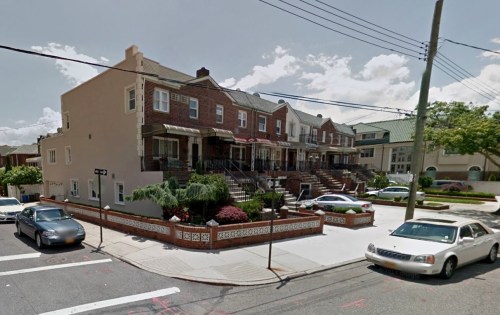
I feel confident, then, in stating that Louis Saphier’s “neck road farm house” of July 1942 was, in fact, the Agnes Lake House, which stood at 420 (or 424; the number wavered) Gravesend Neck Road between East 4th and 5th Streets. In her book Old Dutch Houses of Brooklyn, historian Maud Esther Dilliard placed its construction around 1832. Other sources suggest it was built as early as 1812. It seems to have disappeared sometime between 1951 — it is just visible in a blurry aerial view photographed that year (accessible at this link by clicking on “Map Type” and selecting “1951 Aerial”) — and 1956/57, when it was replaced by the row of seven brick houses currently standing at 410-424 Gravesend Neck Road. They were ready for occupancy on April 26, 1957.

Neck.Road.replacements.2012.June

The houses that replaced the Agnes Lake House at 410-424 Gravesend Neck Road as they appeared in June 2012. Courtesy of Google Maps (https://goo.gl/maps/S7rrB).


Copyright © 2015 by Joseph Ditta (webmaster@gravesendgazette.com)

3 Comments

Filed under Agnes Lake House, buildings, Gravesend Neck Road, Lake family, Louis Saphier, Maud Esther Dilliard

Gravesend Characters Past: Charles E. Morris (1858-1925)

Continuing the challenge posed by my fellow members of the Society for One-Place Studies that we blog about 52 residents of our respective places in as many weeks, here is a profile of Charles E. Morris from The Eagle and Brooklyn: The Record of the Progress of the Brooklyn Daily Eagle Issued in Commemoration of its Semi-Centennial and Occupancy of its New Building; Together With the History of the City of Brooklyn From its Settlement to the Present Time, edited by Henry W. B. Howard (Brooklyn, N.Y.: The Brooklyn Daily Eagle, 1893), vol. 2, 1140-1142:

SCAN0265

Charles E. Morris (1858-1925)

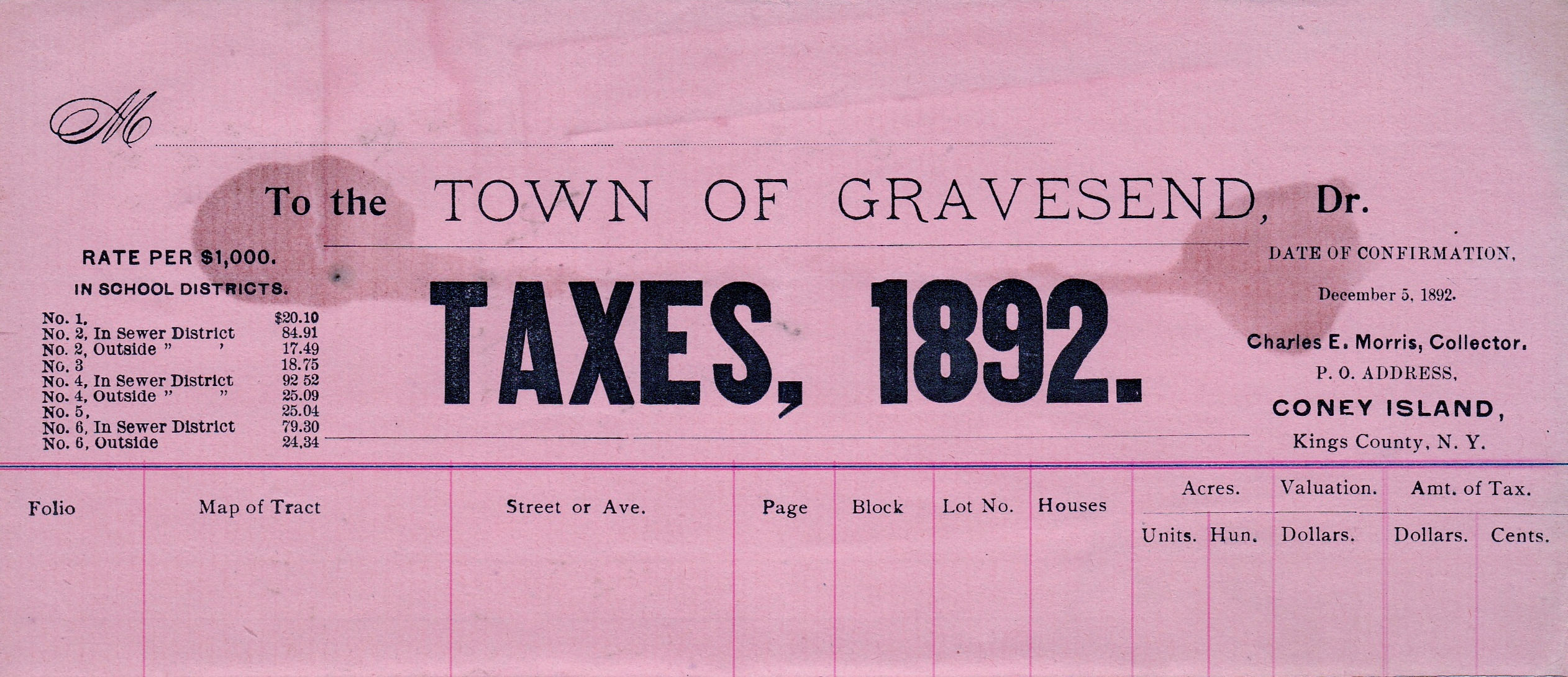
Filling the position of collector of the town of Gravesend, Charles E. Morris, since his election in the fall of 1891, has performed his duties in a thorough and efficient manner. Mr. Morris was born at Gravesend, on November 21, 1858. His paternal ancestors for some generations have been natives of that town, being direct descendants of the famous Gouverneur Morris. For five years young Morris attended the public school in his native town, and subsequently, public school No. 10, in Brooklyn, where he was graduated in 1876. He then became identified with the Knickerbocker Ice Company, and in a very short time was placed in charge of the business of that corporation at Coney Island. This position he retained for many years. He has been an active member of the John Y. McKane Association ever since its organization, on for the past four years he has been a delegate to the Democratic General Committee, from Gravesend. Since 1887 he has been clerk to the board of health of Gravesend, and from the beginning of 1892, of the street improvement and town boards. He was one of the commissioners appointed to superintend the grading and construction of Surf avenue. He is secretary to Atlantic Hook and Ladder Company of the Coney Island fire department, and is president of the Atlantic Gun Club.

Morris.Charles.tax.billhead.1892.copy2

Billhead for Charles E. Morris, Collector of taxes, Town of Gravesend, 1892. {Collection of Joseph Ditta.}


Copyright © 2015 by Joseph Ditta (webmaster@gravesendgazette.com)

Leave a comment

January 22, 2015 · 12:01 am