The Mud-Gutter Band


Post-1907 real photo postcard identified on back as “Ed Clark’s Band, Brooklyn, NY / X is Ed.” (Collection of Joseph Ditta)

Occasionally a small group of street musicians would find our community. On impressive brass horns which could be heard a long way off they played rollicking numbers, filling the children with excitement. Their serious, energetic approach and the loudness of their music on the quiet lanes amused the farmers who, to please their offspring, sent coins for these impromptu concerts, but among themselves, called the invaders, “The Mud-Gutter Band.” — Gertrude Ryder Bennett, Living in a Landmark (Francestown, New Hampshire: Marshall Jones Company, 1980), 65.


Copyright © 2014 by Joseph Ditta (webmaster@gravesendgazette.com)

2 Comments

Filed under Bennett family, Gertrude Ryder Bennett, Wyckoff-Bennett Homestead

Dandelion Wine

Charles W. Bauhan (1861-1938), sketch of a dandelion gatherer, April 25, 1911. (Collection of Joseph Ditta)

Charles W. Bauhan (1861-1938), sketch of a dandelion gatherer, April 25, 1911. (Collection of Joseph Ditta)

In the early years of the twentieth century, after the Bennett family sold the bulk of the farmland surrounding their Gravesend homestead — the Wyckoff-Bennett House at 1669 East 22nd Street — the soil, no longer planted to crops, erupted in wildflowers. “The land, waiting to be developed, turned into meadows where as a child I gathered wild strawberries. Elderberries ripened for jelly, blackberries for pies.” So recalled Gertrude Ryder Bennett (1901-1982) in her memoir, Living in a Landmark (Francestown, New Hampshire: Marshall Jones Company, 1980). “In early spring each year, colorful dandelion gatherers came from the city with knives and worked in the meadows until almost sunset, filling huge bags and taking them away.” Gertrude’s mother, the poet Nellie May Bennett (1873-1951), penned a sonnet inspired by one of these women:

DANDELION GATHERER

A hungry hawk could be no more intent
Than she with yellow kerchief, crimson shawl
And purple apron. Shabby, shapeless, bent
Above the field with eager blade, the call
Of mating robins fails to flush her seamed
And sallow cheek. Could she have been that gay
And blushing, dark eyed flower girl who dreamed
Of love and life in newer lands one day
In Italy? . . . With bold dexterity
She cuts the tender weeds, a silent thing
That moves from patch to patch inquiringly.
A leaf of autumn in a field of spring.
Upon her head she lifts her bulging load
And stately, proudly takes the dusty road.

Charles W. Bauhan (1861-1938), Dandelion gathering, April 25, 1911. (Collection of Joseph Ditta)

Charles W. Bauhan (1861-1938), Dandelion gathering, April 25, 1911. (Collection of Joseph Ditta)


Copyright © 2014 by Joseph Ditta (webmaster@gravesendgazette.com)

Leave a comment

Filed under Bennett family, buildings, Charles William Bauhan, Gertrude Ryder Bennett, Gravesend artists, Wyckoff-Bennett Homestead

Gravesend’s Little Chapel That Could

At the end of the long drive that runs beside the historic Ryder-Van Cleef House at 38 Village Road North, stands an odd structure that is hard to see clearly from the sidewalk, shrouded as it is by dense foliage today. Back on an overcast spring day in 1986, it looked like this:

Side view of 38 Village Road North taken Wednesday 9 April 1986. Note chapel behind the tree. (Collection of Joseph Ditta)

Side view of 38 Village Road North taken Wednesday 9 April 1986. (Collection of Joseph Ditta)

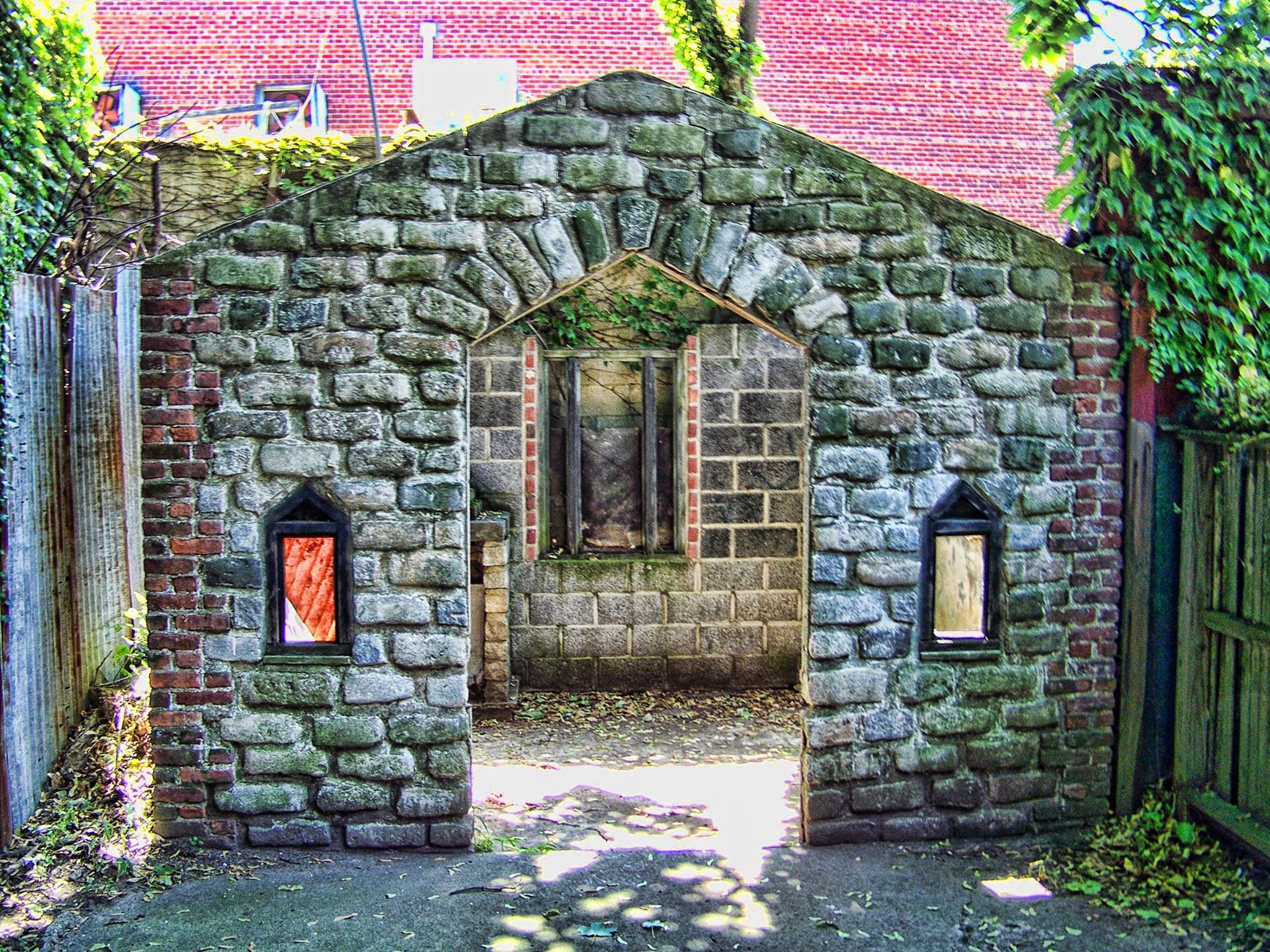
Although it was then blocked by a tree, its alignment with the driveway suggests the little building might once have been a garage. But its entrance seems too narrow for a car. And why would a garage have a Gothic-arched doorway with similar, flanking windows? (See the closeup below.) Like other sites in Gravesend, legend surrounds this one, fed, no doubt, by the pull of that sinister black portal.

Closeup of the chapel behind 38 Village Road North, taken Wednesday 9 April 1986. (Collection of Joseph Ditta)

Closeup of the structure behind 38 Village Road North taken Wednesday 9 April 1986. (Collection of Joseph Ditta)

A friend who grew up a few houses down doesn’t recall the place ever in use. She was too scared to go near it, and in her 29 years there, worked up the nerve to look inside just once, when she saw what looked like an altar. Turns out it was an altar, but not one for human sacrifice.

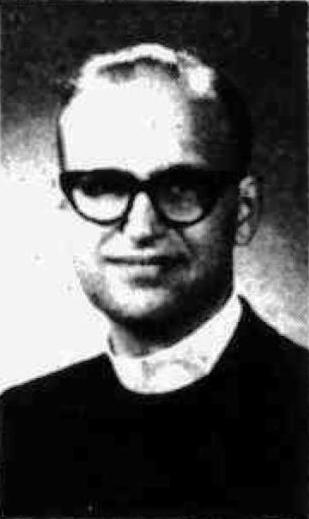
Around 1943 an enterprising young Lutheran divinity student named William George Luger (born 1927), who lived with his family at 30 Village Road North, decided to build a devotional chapel. The Lugers owned the three houses at 28, 30, and 32 Village Road North, so it is a mystery why William chose a spot behind number 38 on which to build. Presumably he did so with the owner’s permission. On a plot 12′ x 12′ he constructed a building of discarded brick and cobblestone scrounged up from vacant lots in the neighborhood. He furnished it with benches and imitation stained glass windows, and even managed to squeeze in an organ (probably a reed organ). Between June 1944 and Christmas 1945, the incipient Reverend Luger preached on Sundays to a congregation as large as 17 members in his tiny chapel. Luger was appointed assistant to the pastor of St. Stephen’s Lutheran Church on Newkirk Avenue on 6 January 1946, a month before his family moved from Village Road North. The Brooklyn Eagle mourned the abandonment of his endearing and short-lived house of worship (see below).

“Reverend 12 x 12 ” went on to a distinguished career at multiple churches in the United States. His little chapel on Village Road North still stands, now roofless and empty. The organ is gone, its music only an echo. And the congregation, only a memory.

The chapel behind 38 Village Road North as it looked on Sunday 25 August 2013. Photograph by Lisanne Anderson.

[Please note: This post does not constitute an invitation to visit the chapel, which stands on private property.]


Copyright © 2013 by Joseph Ditta (webmaster@gravesendgazette.com)

Leave a comment

Filed under churches, Ryder-Van Cleef House, Village Road North

Thanksgiving, Gravesend style!

On its front page for Friday 30 November 1923, the Brooklyn Daily Eagle ran the following tale, which could only have happened in good old Gravesend, Brooklyn. Happy Thanksgiving!

TURKEY CHASE IN CEMETERY; BIRD GETS AWAY

Pipenbring Had Won It at Raffle and Wife Had Given One He Bought to Church.

A wild chase after a live turkey, and in a cemetery at that, was the strange pastime indulged in by several prominent members of the Gravesend Civic Association, headed by the president, Edward Pipenbring, in the wee sma’ hours of Thanksgiving morning. And the lively bird got away from his pursuers at that by flying over the cemetery fence.

Mrs. Pipenbring, the good wife of the president of the G.C.A., had just put the finishing touches to a fine $8 turkey intended for the family dinner on Thursday when her phone bell rang.

The cheery voice of Friend Husband announced with glee that he was the lucky winner of a real live turkey at the rooms of the G.C.A. He suggested to his wife that she take the large, juicy turkey that she had prepared for the oven around to a church euchre and offer it as a special prize.

Mrs. Pipenbring carried out her husband’s idea and lugged the turkey around to the hall, much to the delight of a lady who won ten games out of a possible ten.

Mr. Pipenbring grabbed the live “turk” by the legs and started a triumphal march homeward, trying to look like a lithograph of a Pilgrim Father. When they got to Village rd., where the old Gravesend Cemetery is located, a bad spot in the street caused “Ed” to stumble. The bird took a mean advantage, freed himself and scooted into the cemetery. Then the merry chase began, the like of which Gravesend has not seen in a few hundred years. In and out among the old gravestones dodged the turkey, with “Ed” calling to him.

“Safety first” seemed to be the bird’s motto, and finally he flew over the high picket fence and disappeared into the shadows. The hunters gave it up and went their ways.

Mr. Pipenbring was up bright and early and bought another bird for $7. With the $8 bird he gave away, the $7 one he ate and the $1.20 he paid at the raffle for the turkey that got away[,] his Thanksgiving dinner was a bit expensive. He is hoping some one may find his prize bird and return it in time for Sunday’s dinner.

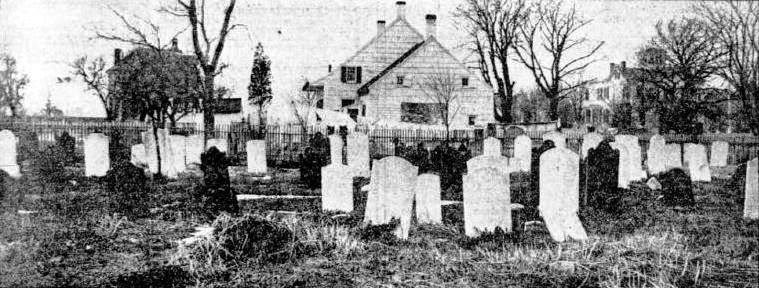
In the early years of the 20th century, the Gravesend Cemetery was enclosed by a low picket fence (perfect for hopping by escaping turkeys), which is just visible in this 1905 view looking west towards Van Sicklen Street. The large house at center, one of several belonging to the Lake family, stood where Corso Court is today.


Copyright © 2012 by Joseph Ditta (webmaster@gravesendgazette.com)

Leave a comment

Filed under Gravesend Cemetery, holidays

Which farmhouse was it? And what’s it got to do with Bob Hope? Funny you should ask….

In honor of the 70th anniversary of its creation this month, I hung a mystery painting above my bed. It doesn’t look terribly mysterious, and I’m sure those of you with a trained eye might say it isn’t even a very skillful picture. It shows a pleasant if somewhat lopsided wood-framed house set snugly amidst a riot of blooming shrubs. An empty stool beside a small basket near the stoop suggests the occupant has slipped inside to escape the summer heat. We can almost hear cicadas droning from the shady trees behind the house.
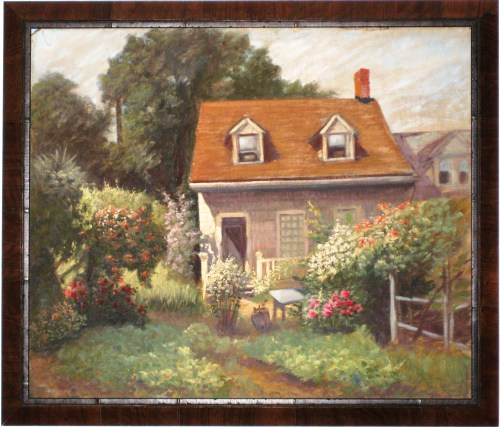
“Neck Road Farm House, Brooklyn, N.Y., painted by Louis Saphier, July 1942” (Collection of Joseph Ditta)

The painting and its maker are identified on back: “neck road / farm house / Brooklyn / N.Y. / painted by / Louis Saphier / July 1942.” What makes it so mysterious? Try as I might — and believe me, I’ve tried — I cannot discover where this house stood.

In 1945, just three years after Saphier painted this farmhouse of clearly Dutch-American design — instantly recognizable by its ski-sloped roof overhanging the front porch — the historian Maud Esther Dilliard published Old Dutch Houses of Brooklyn, a survey of the borough’s surviving structures in that distinctive style. As she lamented,

It was not so long ago that many of [the] houses [of Brooklyn’s original settlers], and the houses of their children and grandchildren, were standing, but modern business is causing these old buildings fast to disappear. In order that their early owners, the founders of Kings County, may not be forgotten in the hurly-burly of twentieth-century Brooklyn, I have written the stories of all the ancient dwellings which are now in existence — or were at the time their photographs were taken.

Dilliard recorded just four Dutch houses on Gravesend Neck Road:

  • No. 27: Van Sicklen House
  • No. 110: Abraham Emans House
  • No. 424: Agnes Lake House [some sources give this as 420]
  • No. 1240: Voris-Shepard House [Dilliard mistakenly calls this 1040]

Only No. 27, the Van Sicklen House (better known as the Hicks-Platt or “Lady Moody” House), stands today. No. 110, the Abraham Emans (or Emmons) House, disappeared between 1945 and 1951, and the Voris-Shepard House, at 1240, was demolished for an apartment building by 1961. None of these had the same layout as Saphier’s farmhouse, but Agnes Lake’s, at 424 (or 420) Neck Road, which was replaced by 1956, came very close. It stood on the south side of the street, and its rear facade bore the correct profile — the three-bay-wide Dutch portion to the left, an addition to the right, and a chimney between — but we do not know if it had dormer windows. (Its north, or street, facade, was “Victorianized” around 1890 through the addition of the tower seen in this 1931 photograph.)

So which house did Saphier paint? Did it vanish between July 1942 and the publication of Dilliard’s book in 1945? Actually, the margin is even narrower: Dilliard published a serialized version of her text in Long Island Forum between November 1943 and March 1945. The structures she covered in both journal and book are the same, so the building Saphier painted, if indeed it was an undocumented Dutch farmhouse on Gravesend Neck Road, would have disappeared in the sixteen months between July 1942 and November 1943, when Dilliard began her series.

From at least 1925 until his death in 1954, Saphier lived at 1544 East 17th Street, between Avenues O and P. Assuming he traveled south down East 17th Street that day back in July 1942, one wonders which direction he turned upon reaching Neck Road. In the 1920s Eugene L. Armbruster photographed practically every Dutch farmhouse then standing in Brooklyn; combing through his shots along the length of Neck Road has not revealed an obvious candidate for the one Saphier captured. The 1939-1941 tax photographs at the New York City Department of Records and Information Services (a.k.a. the Municipal Archives) might include the house closer to the period Saphier painted it, but searching them will have to wait until I find the time or the Municipal Archives digitizes the series, whichever comes first. Maybe Saphier simply painted from memory a long-vanished house he recalled from his walks. Who knows?

The artist himself, while not completely unknown, is not terribly well documented either. Incidentally, his son, James L. Saphier (1907-1974), was for nearly forty years Bob Hope’s business agent. In 1945 the elder Saphier did a lifelike portrait of Hope which sold at auction a few years back for $20,800.

Perhaps from its presence above my bed at night Saphier’s farmhouse painting will seep into my dreams and subconsciously supply the location of this lost corner of Gravesend.

Louis J. Saphier (1875-1954), portrait of Bob Hope, 1945.

UPDATE: The painting has since been positively identified as the Agnes Lake House; see this followup post.


Copyright © 2012 by Joseph Ditta (webmaster@gravesendgazette.com)

4 Comments

Filed under Bob Hope, families, Gravesend artists, Hicks family, Louis Saphier, Maud Esther Dilliard, Van Sicklen family