When the Sea Beach Line Was New

Work has begun on a four-year, 395-million-dollar project to revitalize the nine crumbling, open-air platforms and stations of the N line subway, still called by many the “Sea Beach Line,” after the Sea Beach Railroad, the late nineteenth-century Coney Island excursion route it replaced in 1914-15. Here is a photo of one of the N’s station houses (it is unidentified, but all the stations followed this basic design), taken when the line had just been completed in 1915. It comes from a publication showcasing the Associated Tile Manufacturers, who furnished the pattern of “reds, browns and greens on a ground of light tan.” Let’s hope the expensive and lengthy restoration returns us to this dignified past.
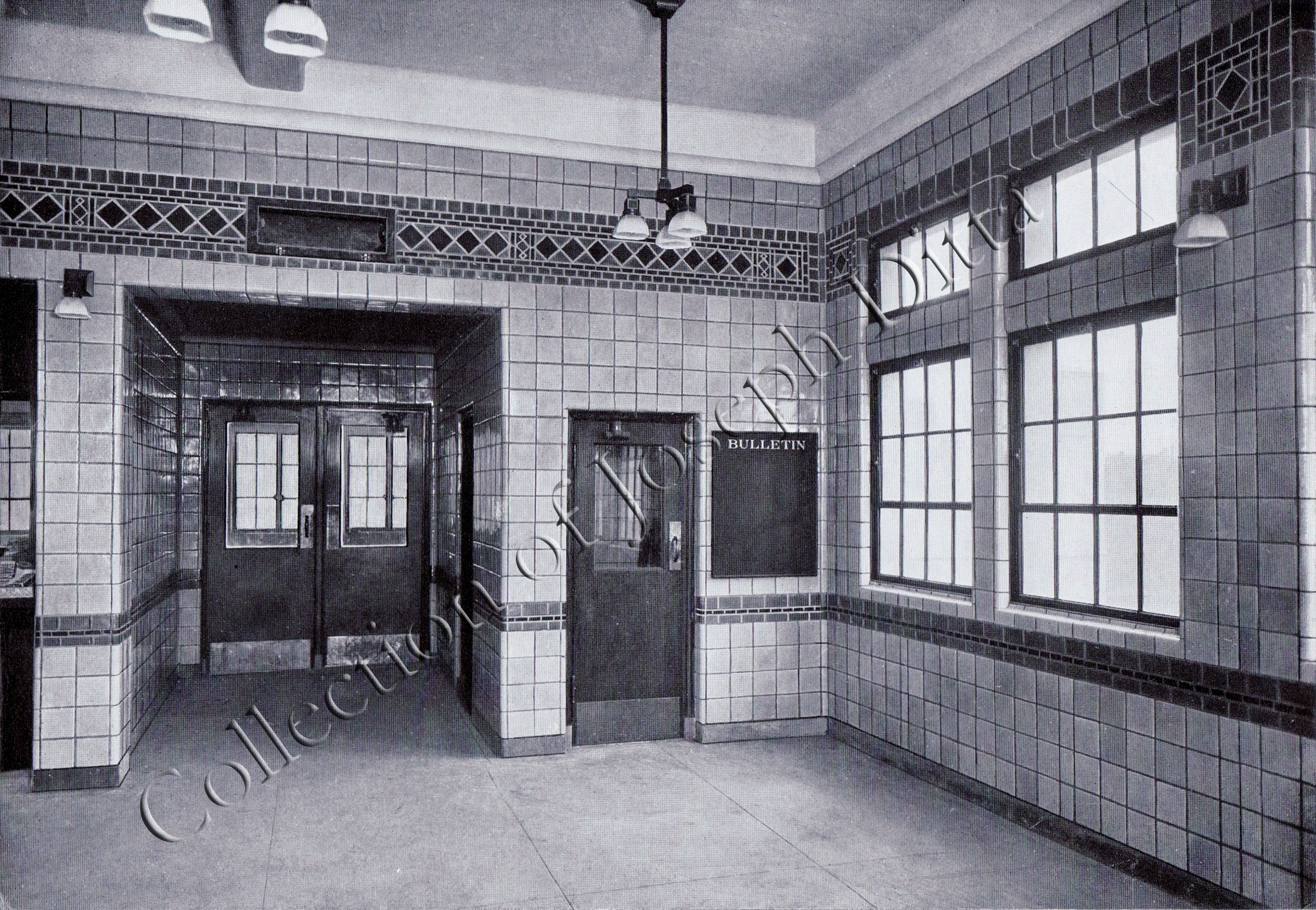
Sea_Beach_station_house_tiles_cropped_watermarked

“Station Building, N.Y. Municipal Railway, Sea Beach Line, Brooklyn, N.Y.” {Collection of Joseph Ditta}


Copyright © 2016 by Joseph Ditta (webmaster@gravesendgazette.com)

2 Comments

Filed under Sea Beach Line

Everybody Dance!

The number of social clubs that proliferated in Gravesend — and every other small American town for that matter — at the end of the nineteenth century boggles the mind. Every young person belonged to every other young person’s club. Here, Annie Kreyer, daughter of hotel keeper John G. Kreyer, invited friends to an evening’s entertainment at her father’s establishment on the southeast corner of Kings Highway and Coney Island Avenue.

Invitation to the first annual masquerade of the Olive Social Club at Kreyer's Hotel, Gravesend, January 7, 1891. {Collection of Joseph Ditta}

Invitation to the first annual masquerade of the Olive Social Club at Kreyer’s Hotel, Gravesend, January 7, 1891. {Collection of Joseph Ditta}

I’ve not yet found a description of Annie Kreyer’s party, but it probably followed the pattern described by Gertrude Ryder Bennett in her Turning Back the Clock in Gravesend: Background of the Wyckoff-Bennett Homestead (Francestown, New Hampshire: Marshall Jones Company, 1982), 76:

Usually in the autumn, a group of young people appointed a committee which arranged for monthly dances to take place during the winter, and decided in whose homes these would be held. The women supplied the refreshments and the men furnished the music. The hostess tacked unbleached muslin over her ingrain carpets to make dancing easier and to preserve the original floor covering from the lively heels of her guests. How they enjoyed the Saratoga lancers, schottisch, Virginia reel, quadrille and the polka! Of course the waltz, with its romantic appeal, bid high for popularity. / . . . / Everyone liked games as well as dancing. “Throw the handkerchief,” “Going to Jerusalem” [better known as musical chairs], “Charades” and those “slightly naughty” ones which offered the opportunity to hold hands. During an evening the guests clustered around the piano or organ singing popular songs like “Asleep in the Deep,” “Alice, Where Art Thou?” and “Love Me and the World Is Mine,” interspersed with patriotic music and hymns.


Copyright © 2016 by Joseph Ditta (webmaster@gravesendgazette.com)

Leave a comment

Filed under Coney Island Avenue, Kings Highway

Der Koloss Elefant auf Coney Island

Most of you know of (and kindly indulge) my obsession for Elephantine Colossus, the giant tin-skinned, elephant-shaped structure that stood on Coney Island between 1884 and 1896. Here’s my latest find, which arrived today all the way from Germany (you’ve got to love eBay!). It’s a page from the Illustrirte Zeitung [or Illustrated News] for August 1, 1885, showing our Elephant in head-on and X-ray views. These are the same images that accompanied a Scientific American feature a month earlier. If anyone reads German, I’d love to have a translation of the article in the left column — “Der Koloss von Coney-Island” — though I suspect it’s the same recitation of hyperbolic statistics that followed the Elephant wherever he went!

"Der Koloss von Coney-Island," Illustrirte Zeitung, August 1, 1885, p. 119. [Collection of Joseph Ditta]

“Der Koloss von Coney-Island,” Illustrirte Zeitung, August 1, 1885, p. 119. [Collection of Joseph Ditta]

Scientific.American.1885.07.11

“The Colossal Elephant of Coney Island,” Scientific American, July 11, 1885. [Collection of Joseph Ditta]


Copyright © 2016 by Joseph Ditta (webmaster@gravesendgazette.com)

Leave a comment

Filed under Coney Island, Elephantine Colossus

1601 Avenue T

Here’s a rare postcard view (actually, it’s probably unique) of the house at 1601 Avenue T, at the northeast corner of East 16th Street, next to a 2015 shot of the house by Lisanne Anderson. It was built early in the twentieth century as part of the real estate development called Homecrest. The house retains its basic shape despite the changes to its skin over the last hundred years. Its immediate neighbor at 1607 Avenue T has fared less well.


Copyright © 2016 by Joseph Ditta (webmaster@gravesendgazette.com)

Leave a comment

Filed under Avenue T, Homecrest

Don’t Blink!

Happy New Year! I think I’ll start sharing more images from my ever-growing collection of Gravesendiana because, well, everyone loves a good picture, right? I’ll put them up and let them speak for themselves. If the mood strikes me, and if time is on my side, I can always go into detail. But to make life easier — and to keep you interested, hopefully! — I’ll try to post more frequently and simply. And please remember: your comments are always welcome!

Here is the last purchase I made in 2015. It arrived, nicely, on January 2nd. It is a postcard, mailed on October 9, 1908, by Anna Studwell, of 1634 West 2nd Street, between Avenues P and Q (Avenue Q had not yet been renamed Quentin Road) in the now-forgotten real estate development of “Marlboro” (misspelled “Marboro” in red ink on the front of the card, just like the lost Marboro Theatre on Bay Parkway, which many of you will remember). She invites a friend or family member from Manhattan to come out to see the house with these simple directions: “Take Culver train [today’s F line] and get off Ave. P. Walk west, you will see house.” In 1908, there was little else to see on the largely empty blocks of Marlboro.

Although its skin had been modernized over the years, the house remained largely the same (it was rather plain to begin with). It stood until last fall, when it was demolished to build a mini-mansion on the site. I didn’t want this to be a sad post, but hope it serves as a reminder to keep your eyes peeled before every last scrap of Gravesend history disappears before we know it.


Copyright © 2016 by Joseph Ditta (webmaster@gravesendgazette.com)

2 Comments

Filed under Marlboro, West 2nd Street