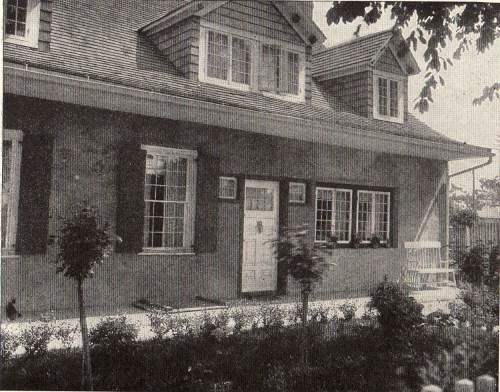
In response to the recent interest in the historic house at 27 Gravesend Neck Road, a.k.a. “Lady Moody’s House,” – generated by the Landmarks Preservation Commission’s attempt to “de-calendar” the property from its list of potential designation sites – we are presenting, in full, Isabelle Platt’s article, “An Old Colonial Homestead Born Again,” which appeared in Country Life in America, vol. 16, no. 2 (June 1909). Mrs. Platt and her husband, the real estate speculator William E. Platt (whose accompanying photographs appear here in slightly reordered form), bought the house in 1904 from the heirs of the Hicks family, who had held the property since 1842. The Platts, by this article, bestowed the name “Lady Moody Homestead” on this building which stands on land once owned by the founder of Gravesend, but which likely dates from after her lifetime (she died in 1658). It is a convenient name, one that to this day reminds the neighborhood of its remarkable founding mother.
Although Mrs. Platt’s flowery language and dreamy tales of George Washington and Pieter Stuyvesant should be read with a healthy dose of skepticism, her article provides a fascinating glimpse of the layout of this ancient Gravesend dwelling, and of the “restoration” practices of the early 20th century. Platt’s finished product was a highly romanticized version of a Colonial farmhouse, but a very beautiful one, nonetheless. One imagines it would be relatively easy to peel off its current skin of false stone and stucco to return the house to its 1909 state.
One bright June morning, while strolling along an old country road, I suddenly came across a delightful, rambling, old-fashioned house – delightful indeed from an artistic point of view.
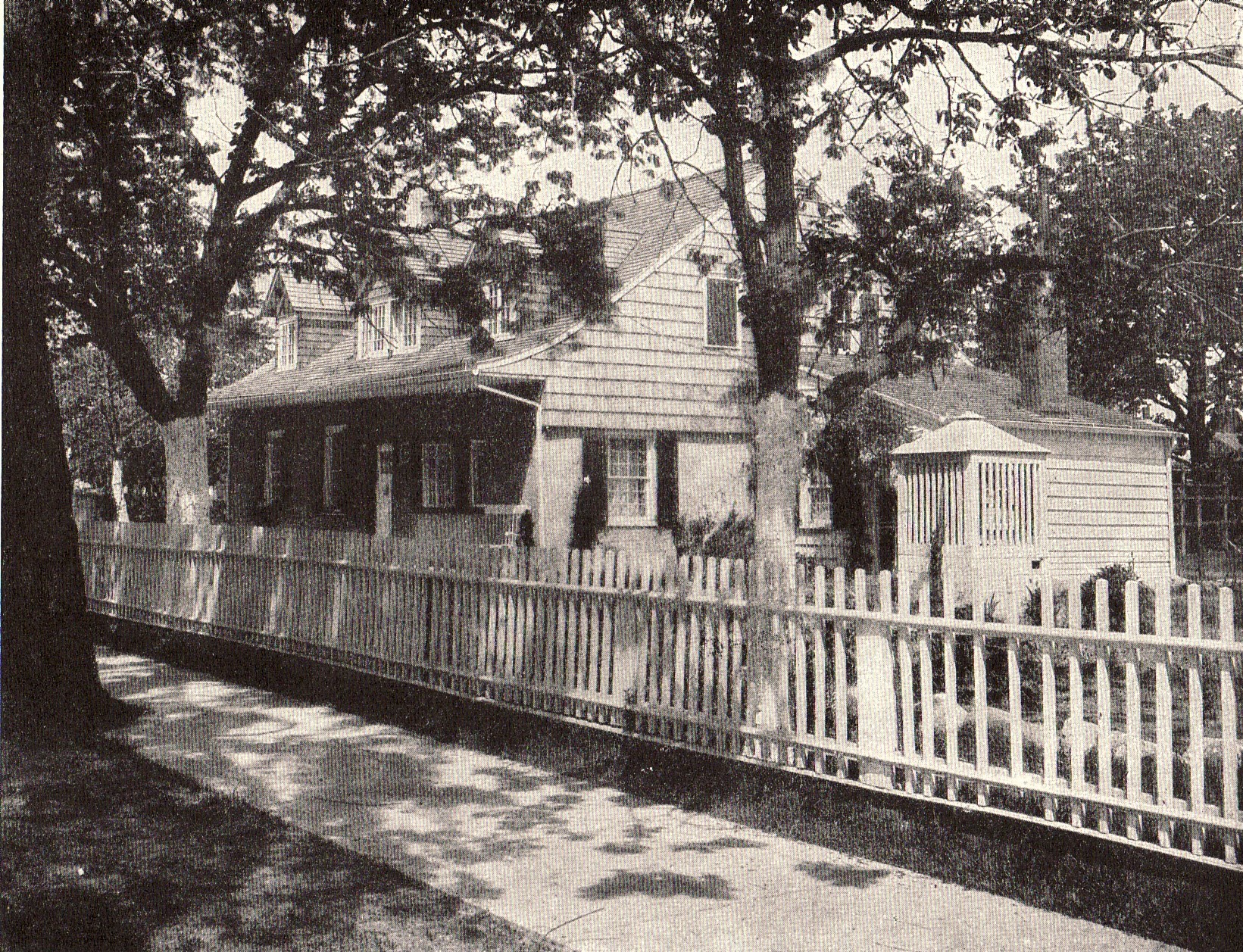
The shingles on the roof were covered with moss. A few pickets were off the fence. Some gay-colored hollyhocks and an ancient quince tree, gnarled and twisted with age (it had not been pruned in many years), broke the line of the white-washed west wall. In the background of the house stood some very old apple and pear trees.
At a glance I could see it was a rare subject for a painting, and having my materials with me I sat down and sketched in the shade of a great willow tree. It was a quiet hour of the day; the ever inquisitive small boy was not in evidence. As my sketch progressed one of the old residents who was passing, stopped, smiled pleasantly and said, glancing over my shoulder: “I am seventy years old, and I was born in that house. It was then the oldest house in this place, which is the oldest village on Long Island.”
Eleven years after[,] I chanced to pass through an auction room, and noticing the crowd found they were about to sell the subject of my sketch. On one side of the auction room were the sad-eyed partitioners whose homestead was being sold to divide their estate. On the other side were the idle onlookers – the disinterested men who wanted to buy it, if it went cheap – curious neighbors, real estate speculators, and the usual crowd that hangs around the sale of a piece of country property.
Stepping up on his box the auctioneer read a brief description of the property, and the sale started. A ridiculously low bid was made by a little man. This brought a laugh from the spectators and raised the ire of the auctioneer, who squelched “Mr. First Bidder,” and he disappeared in the crowd.
Bids followed slowly from the different neighbors. Taking advantage of a lull in the bidding, I offered a substantial increase over the last bid. The auctioneer gave me a pleased look of admiration. Looking at his audience he said, “Here’s an outsider bidding. She knows what the property’s worth!” His eloquence was of no avail. Turning to some countrymen who had been glaring at him, speechless, he cried, “Don’t be clams! Give us a bid.” No reply came. Then followed the familiar cry: “Going once! Going twice! Third and last call. Sold!” And the old place, with all the charms of its antiquity, its ancient, romantic history, that had watched the birth of many generations, was knocked down to me.
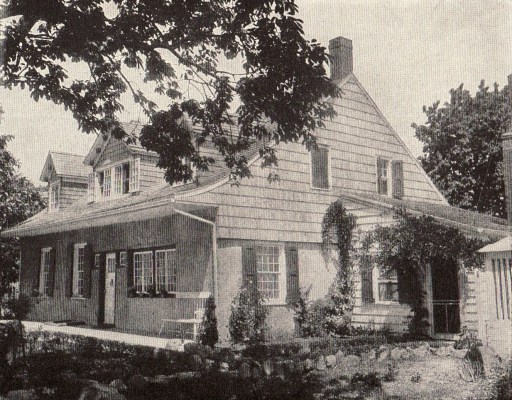
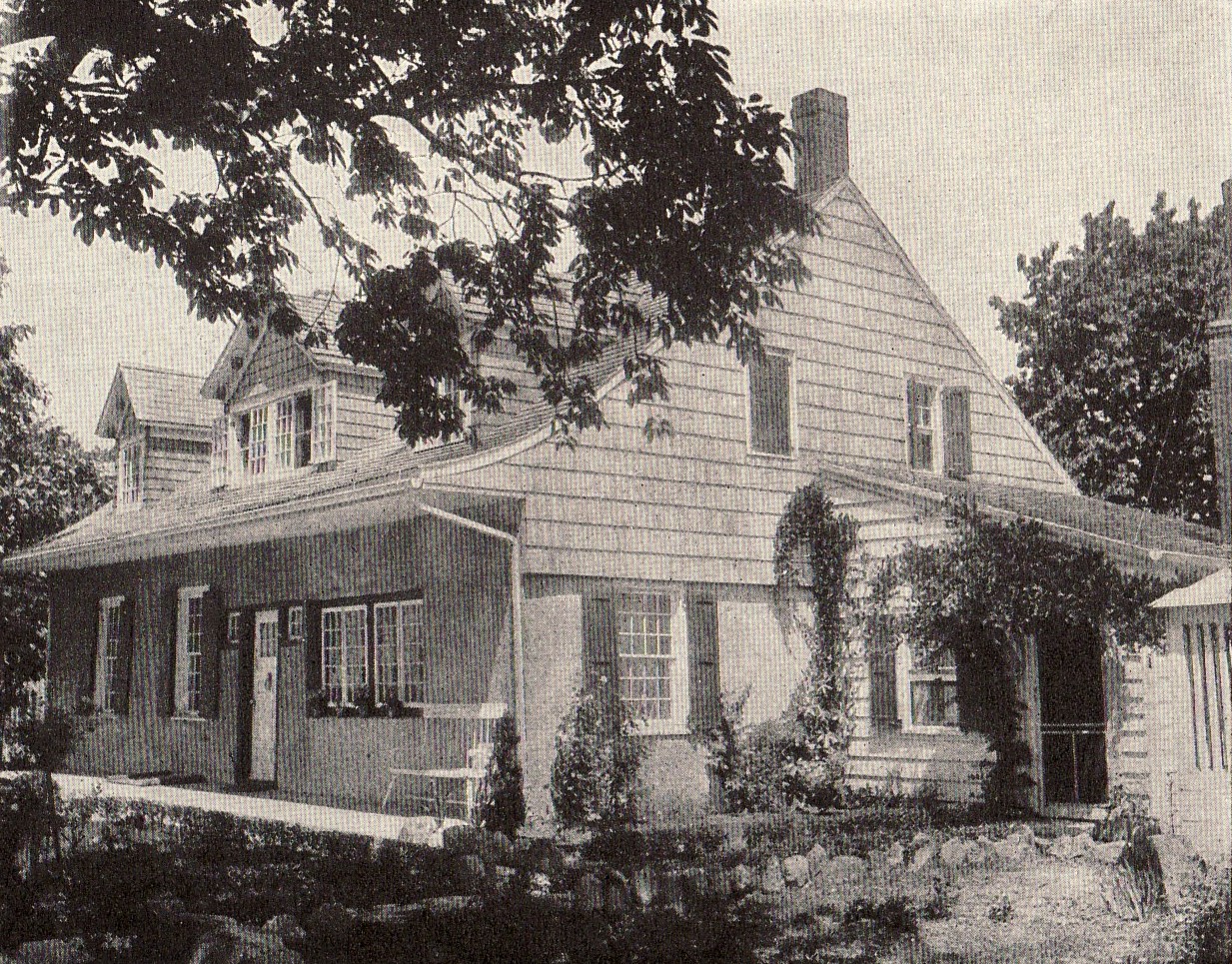
“The Lady Moody Homestead, at Gravesend, L.I. In this long, low, half-stone, half-timber structure both Governor Kieft and Governor Stuyvesant were often entertained. The neighboring colonists took advantage of the protection afforded by its heavy stone walls, and sought refuge here from the Indians.”
Shortly after taking title I visited the homestead. Lifting the latch of the garden gate I walked up the grass-grown path. The air was balmy and sweet with the fragrance of blossoms that covered the trees in the yard. A robin, perched on the roof of the old well-house, trilled what seemed to me a song of welcome. Covering the hood of the lean-to kitchen doorway was a large wistaria [sic] vine in full bloom.
The Dutch door creaked on its time-worn hinges as I entered, and the place seemed strangely still and quiet. A shutter banging in the attic startled me. Although not a believer in ghosts, I must admit that the many stories I had heard left their impression.
Opening the rear kitchen window, I looked out on what had once been a beautiful garden. Old pear, apple, and cherry trees, regal in the splendor and beauty of their pink and white blossoms, seemed to look down disdainfully on the heaps of rubbish that made a motley array about the yard. The grape-arbor and queer little settee underneath were both sadly in need of repair. But the garden, like the house, had great possibilities.
Closing the window and stepping into the living-room, I made a mental survey.
The fireplaces, beamed ceilings, and trim were black with smoke and discolored with age – plainly an evidence of years of neglect, which cast a gloom over the interior. This did not prevent me from admiring the quaint, venerable architecture, and I resolved to restore all the old-time prestige of the place. This resolution was religiously carried out to the best of my ability.
In a few days the work of restoration was begun. A new roof of cedar shingles soon replaced the moss-covered one, which leaked in many places. The outside walls of the first story were of large field stones or boulders, which had received several coats of plaster, paint, and whitewash. This had scaled and fallen off in places, giving the exterior a mottled appearance. These walls were scraped, and then the entire stone-work of the building was covered with a rough grouting of Portland cement.
Underneath the rear of the house was discovered a cellar 12 x 12 feet. This serious drawback of a small cellar was overcome by taking up all the flooring on the ground floor, shoring up the heavy walls (which were 18 to 22 inches thick) from the inside, taking up the oak floor beams and excavating for a more roomy cellar.
Excavating under stone walls is an extremely difficult task. There is danger of undermining. Although the job was offered to several local contractors, it was refused on the ground of being “too risky.” Finally, a number of laborers having been secured, the work was started and successfully carried out.
Holes 9 feet in depth and 4 feet wide were dug at intervals of 4 feet under the walls. Board forms were erected and cement was poured in. These inserts were filled with concrete of Portland cement and small stones; when this had sufficiently hardened the surplus dirt was excavated, this being repeated under the entire foundation until the cellar was completed.
While this work was going on many ancient coins were found, the laborers who discovered them being delighted to exchange them with me for new coins. Another find was a package of Colonial money, two old pewter mugs, and a brass tankard.
The original floor beams – roughly hewn oak timbers – were so hard and bent with age that it was necessary to replace them with new ones. The old flooring being unfit for use, new flooring was laid in all the rooms on the main floor.
The next consideration was the heating. It was thought best to install a steam furnace, and this necessitated the building of a new chimney, as we did not wish to close up the open fireplaces. Close to the outside wall of the building an excavation was made a few feet deeper than the new cellar wall. In this was laid the foundation of a chimney to be built entirely outside of the house. By means of an opening in the cellar wall the chimney was connected with the flue pipe of a steam furnace which thoroughly heats every part of the house. Often the steam is shut off in order that the luxury of blazing wood-fires in the large open fireplaces may be more fully enjoyed.
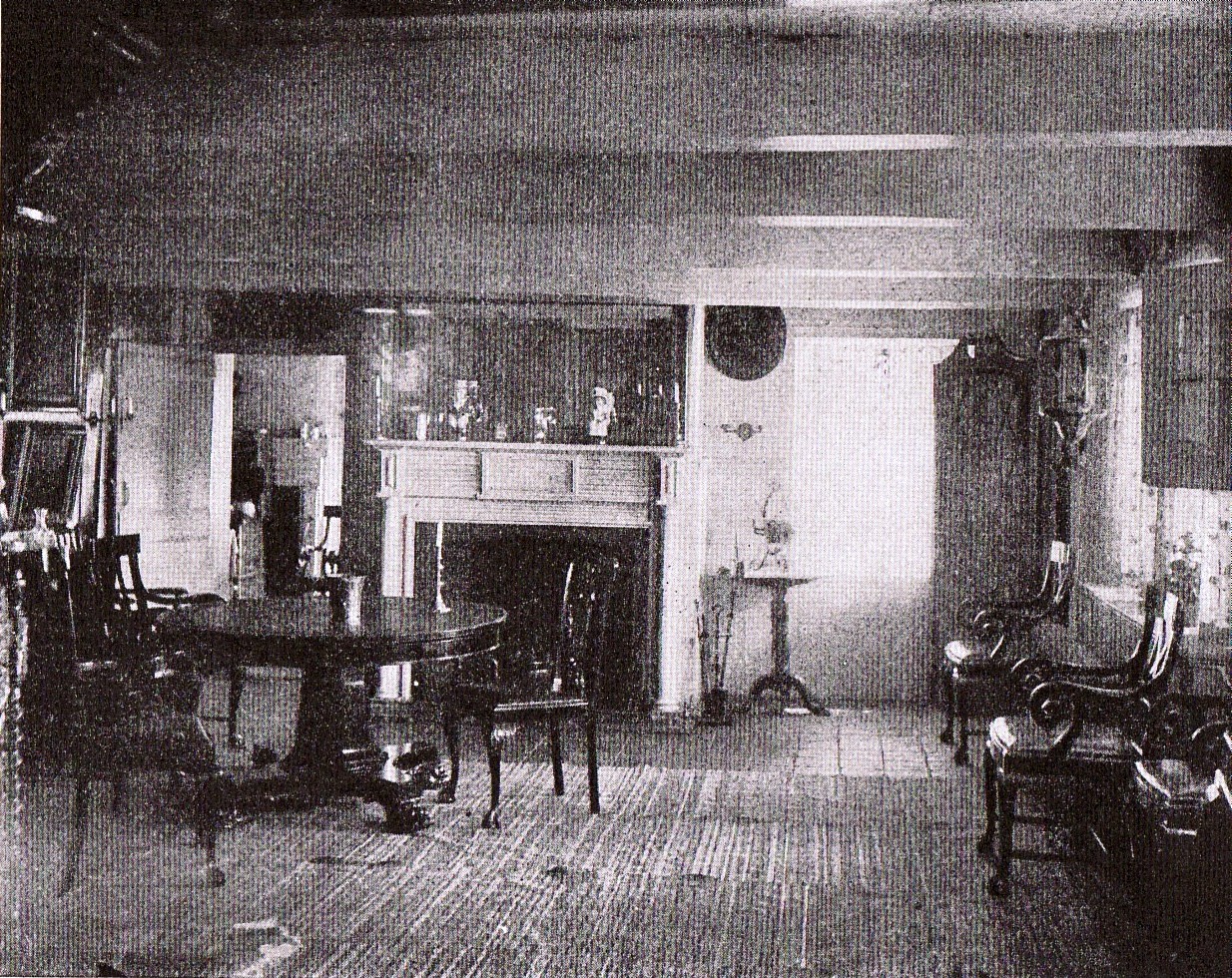
The house, which faces the south, measures 42 feet front by 31 feet deep, with a kitchen wing 14 x 14 feet. In the front there is a general living-room, extending the full width of the building. At either end of this room are two great fireplaces, with large hearths (measuring 17 feet wide by 8 feet deep) of red Holland tiles (8 x 9 inches). The ceiling is beamed; these beams (the largest I have ever seen) still show the marks of the broadaxe, and are 12 x 14 inches.

“The Colonial fashion of combining the dining- and sitting-rooms in one large living room gives an effect of spaciousness even to a small house. The stone walls are two feet thick.”
When I first inspected the room, the walls were covered with an atrocious wall paper. Close examination revealed that it had been plastered on six thicknesses of other paper, each of a different design. On one side, where the paper hung down, the wall was damp. It was found out afterward that this wall had been plastered directly up against the stone-work. We furred this wall with furring strips on which the lath was laid, thus giving an air space and a dry foundation for the plaster, and the dampness disappeared.
All the old paper was scraped from the rest of the walls, which were refinished with a rough coat of white cement plaster. This plaster received several coats of white paint mixed with enough boiled oil to give it a slightly yellow cast. All the wood-work was painted in the same way with the exception of the mahogany rail and newel posts of the stairway. The ceiling between the beams was painted a pale blue. Boiled oil was again used, which gave the blue an antique greenish tinge.
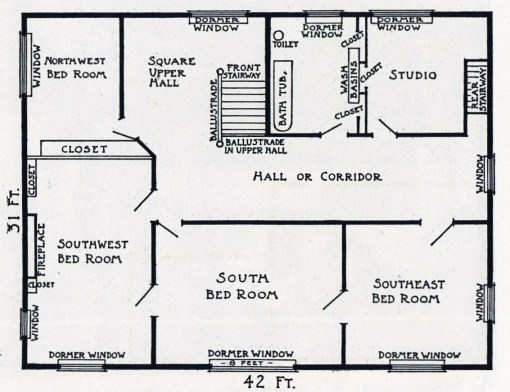
“On the second floor the only modern touch is the bathroom.”
The rear of the house is divided into three smaller rooms, now used respectively as servants’ bathroom, rear entrance to garden and tradesmen’s entrance, storage room for preserved fruits and vegetables (all raised in the garden and carefully preserved in glass), and also a separate storage room for green vegetables, ice, etc.
Beyond these rooms, on the east, is the kitchen wing. This room is very attractive, with its white wainscoted walls and flooring of Dutch tiles. The windows overlook the garden and through the half-open door we catch a glimpse of the old well-house.
The kitchen and bathrooms were the only rooms in the house which had to be brought up to date. Modern plumbing has been installed and a fine new range replaces the primitive cooking apparatus of earlier days.
In placing the wash-tubs, we found the old kitchen window in the way, so this was studded up and plastered over and a high, wide casement window cut into the wall directly over the sink. This window, while being out of the way, yet gives a fine light, and many a busy day’s work has been lightened by that glimpse of the green tree-tops and the blue of the sky.
In the centre [sic] of the living-room there is an antique staircase with old oak treads and mahogany rails and newel posts. This stairway leads into a square upper hall which ends in a long corridor. Into this L-shaped hall open all the rooms of the second story.
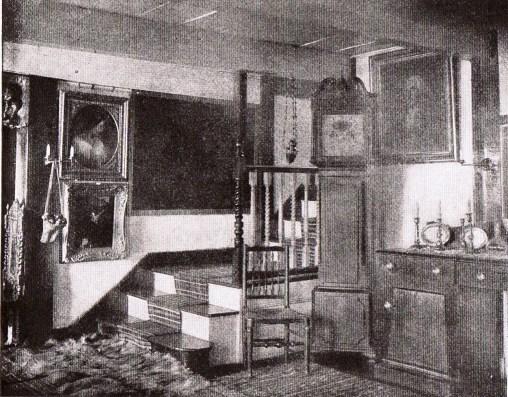
“The antique staircase, with its oak treads and mahogany rail and newel posts, was left undisturbed.”
One of the back rooms was decided upon as a bathroom and it has been fitted up with the best of plumbing, the room directly underneath being converted into a servants’ bathroom.
Four months elapsed. The work of restoration – my labor of love and pleasure – had come to an end, and it was with a great deal of satisfaction that I visited the old house one September afternoon.
As a contrast to my first visit, I approached by the main entrance. Taking hold of the odd [old?], wrought-iron ring latch I turned it to the right; this raised the latch on the inside and the door swung open on its old hinges. Crossing the threshold I realized that I was at last in a house of the days of long ago. Everything was old. There was nothing new; so that if Governor Stuyvesant and his “Merrie Men” should have stepped in, they would have felt perfectly at home. So agreeable was the impression made that September day that no change has since been made.
To the right is a long, English casement window set in solid oak timbers, while suspended from a brass rod overhead hang chintz curtains of an old-fashioned, little, formal rose design on a cream ground, through which the sun-light streams across the window ledge with its pots of bright geraniums and primroses. From a hook in the beam above swings a curious brass lantern as old as the house itself. On the mantels are two pewter mugs, one bearing the date 1655, while a brass jug is dated 1541.

“The great oak ceiling beams are 12 x 14 in., and still show the marks of the broadaxe.”
From the walls look down old portraits. The room is furnished with mahogany and oak in Chippendale and older period designs, some of which was collected on a trip through England. Gay rag-carpet rugs are on the floor. At the foot of the staircase hang the pistols which were taken from the camp of Sitting Bull after his death. In a corner of the west room stands a tall clock in a black oak case, the date showing that it is over 200 years old. North of the west end of this large room is a wing whose walls are covered with ancient paintings. The corner cupboards are filled with rare antique china.
Among some dusty papers in the attic was discovered a written account of the history of the house and of events which happened about that time [sic]. The writing was so faded as to be barely legible and it was with difficulty I made the following notes:
This house, known as “Ye Bouwerie of Lady Moody,” was erected about 1643 on land that was part of a grant received from the Dutch Director General, Governor Kieft.
The oak timbers of which the building was constructed were roughly hewn with a broadaxe from trees in the virgin woods of the neighborhood. The walls were built of large field stones laid in mortar. The lime for this mortar was obtained by burning shells collected on the shore. The plaster for the inside walls was a combination of loam, lime, and straw, plastered on a frame-work of hand-made oak laths nailed with hand-wrought nails on oak studding.

This photograph, from Aymar Embury’s 1913 book, The Dutch Colonial House: Its Origin, Design, Modern Plan and Construction, shows “[t]he living-room of the Lady Moody House, with tile floor and good mantel treatment.”
Here in this long, low, half-stone, half-timber structure, both Governors Kieft and Stuyvesant often enjoyed the hospitality of Lady Deborah Moody, an Englishwoman of letters and the leader of the little band of Colonists among whom she lived. So great was her influence that her advice was sought by both governors on matters relating to the public affairs of the colony.
The early settlers, most of them friends of Lady Moody, were often attacked by the neighboring Indians. Lady Moody’s home seems to have been the principal point of attack. The Colonists took advantage of the protection afforded by its heavy stone walls and at one time it was ably defended by a party of forty men, some of whom had the reputation of being expert Indian fighters.
In the memorable year of 1776 word was received from General Washington to watch the coast for the arrival of the British. Excitement ran high in the little village of Gravesend. In the gray dawn of that summer morning (August 22d) a farmer’s boy crept up the slippery roof of an adjoining barn. Through the mist he watched the advance of the British troops like a long strip of red flannel moving across the meadows.
The battle of Long Island was fought only a few miles distant. When the fighting was over some of the terribly wounded patriots made their way through the British lines, through the woods into the village. It was then that the old house was used as a hospital. There the men were taken care of and carefully nursed by the women of the vicinity. Those that died were laid to rest in the quaint cemetery across the way, now over 250 years old.
Thirteen years afterward General Washington was entertained at this house when he visited the town in 1789.
Many years have passed since then, but the historical old dwelling still stands, practically unchanged, a picturesque, sturdy reminder of bygone days, and a never-ending joy to its present owner.
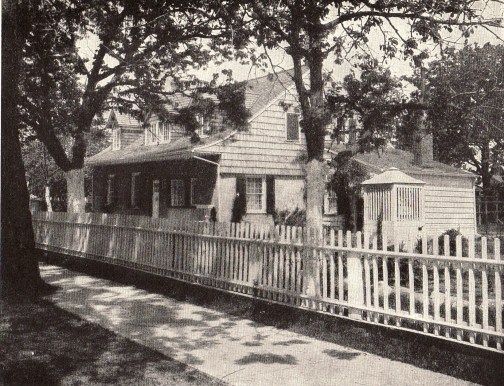
“A less artistic perception might have spoiled this beautiful old Long Island homestead by attempting to remodel rather than to restore it.”
Copyright © 2014 by Joseph Ditta (webmaster@gravesendgazette.com)









 The Gravesend Gazette